vLLM vs SGLang (2026): Which Inference Engine Is Better?
vLLM vs SGLang compared on KV cache reuse, structured output, ecosystem and how to benchmark them on your own workload, with sources and GitHub stats dated 2026-11-22.
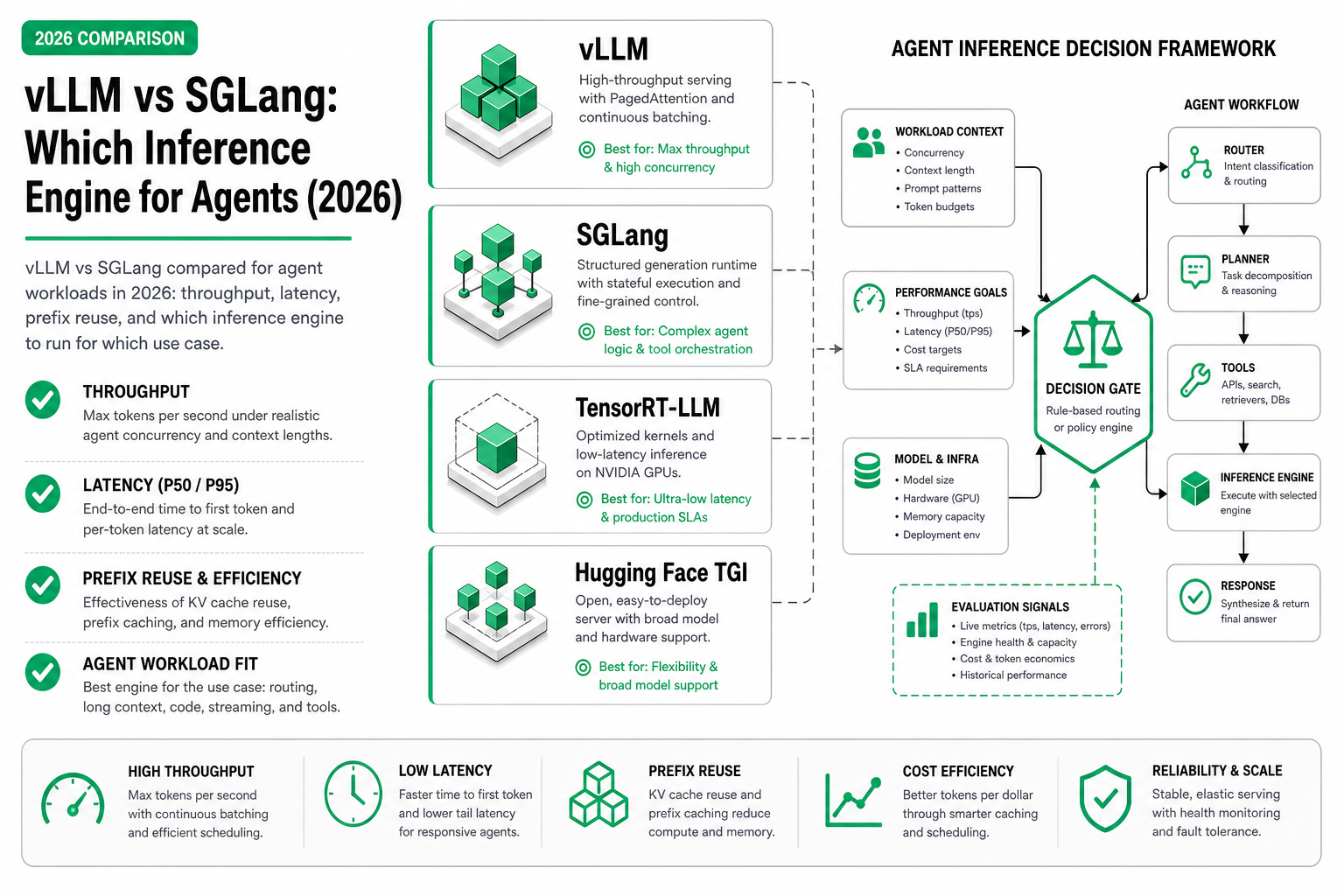
TL;DR — vLLM and SGLang are the two most widely used open-source LLM serving engines. Both expose OpenAI-compatible APIs, both cache shared prompt prefixes, and both support structured output through XGrammar. The design difference is how they reuse KV cache: vLLM matches shared prefixes by block, SGLang keeps a radix tree of cached segments. Which one is faster depends on your model, GPU, batch size and prefix overlap, and published numbers swing a lot, so benchmark your own traffic. As a starting point, vLLM has the larger community (97K stars against 38.9K on 2026-11-22), and SGLang is worth testing first when many requests share long or branching prefixes. Both engines turn GPU memory into served tokens efficiently, so swapping between them is mostly a deployment change, not a code rewrite. The differences that matter show up under agent-shaped load: many concurrent sessions, shared system prompts, conversation histories that grow turn over turn, and structured (JSON) tool-call output. This is the head-to-head. For the full picture on each, see the vLLM deep-dive and the SGLang deep-dive.
The core architectural difference
The comparison comes down to how each engine handles KV cache.
- vLLM → PagedAttention and Automatic Prefix Caching. PagedAttention stores KV cache in fixed-size pages, like OS virtual memory, which avoids fragmentation and packs more concurrent requests onto a GPU. Automatic Prefix Caching lets a new request reuse the cached KV of an earlier request that shares its prefix, so the shared part is not recomputed. vLLM’s docs name long-document queries and multi-round conversations as the cases it helps.
- SGLang → RadixAttention. SGLang keeps a radix tree of previously computed KV segments and looks up the longest shared prefix for each new request, including branching conversations, without manual configuration. For agents, the question is how much of your traffic shares a long prefix and how it branches. When every session starts with the same multi-thousand-token system prompt and the history grows each turn, both engines can skip recomputing what they have seen. A radix tree is a natural fit when prompts branch (retries with edited prompts, tree-shaped tool use), which is why SGLang is worth testing first for those loads. Do not assume the gap is large for simple cases: vLLM’s prefix caching also handles multi-round chat.
Head-to-head
| Dimension | vLLM | SGLang |
|---|---|---|
| KV cache strategy | PagedAttention | RadixAttention (radix tree) |
| Prefix reuse | Automatic Prefix Caching, block-level | Radix-tree prefix matching |
| Structured output | XGrammar or guidance backends | XGrammar (default), Outlines, Llguidance |
| Throughput and latency | Depends on model, GPU, batch and concurrency | Depends on model, GPU, batch and concurrency |
| GitHub stars (2026-11-22) | 97.3K | 38.9K |
| Latest release (checked 2026-11-22) | v0.34.0 (2026-11-16) | v0.5.23 (2026-11-02) |
| RL post-training | Supported inference backend in verl | Supported in verl, with a dedicated SGLang backend page |
| Best fit | Broad ecosystem, mixed workloads | Prefix-heavy, branching agent traffic worth testing first |
| Sources: vLLM docs, SGLang docs, verl docs, GitHub API. | ||
| The table has no latency or throughput numbers on purpose. Published figures come from different models, GPUs, batch sizes and software versions, and both projects ship changes every few weeks. A number copied from one benchmark will not predict your results. |
Benchmark your own workload
Run both engines on the same GPU and model with a request mix that looks like your traffic: your real system prompt, realistic conversation lengths, and the concurrency you expect. Both projects ship benchmark tools:
# vLLM: start the server, then replay a dataset
vllm serve <your-model>
vllm bench serve --backend vllm --model <your-model> \
  --dataset-name custom --dataset-path your_prompts.jsonl --num-prompts 200

# SGLang: launch the server, then run its serving benchmark
python -m sglang.launch_server --model-path <your-model> --port 30000
python3 -m sglang.benchmark.serving --backend sglang --host 127.0.0.1 --port 30000 \
  --model <your-model> --dataset-name random --num-prompts 200
The commands follow the vLLM and SGLang benchmark docs; flags change between versions, so check --help for yours. We have not run them for this article.
Three cautions:
- Prefix caching can inflate repeat runs. vLLM’s benchmark docs warn that repeating
vllm bench serveagainst the same server can reuse cached prompts and inflate throughput. Vary the seed, restart the server between runs, or usevllm bench sweep serve, which resets caches. - Measure what you care about. Compare time to first token, per-token latency and total throughput at your target concurrency, not a single headline number.
- Pin versions. Record the engine version, driver and flags. Results from v0.34.0 and v0.5.23 will not hold after the next release.
Which to choose
Start with vLLM when:
- You want the larger community and the most existing answers and deployment guides
- Your workload is mostly independent requests with little prefix overlap
- You are serving a mix of models and want one well-trodden path Test SGLang first when:
- Agent sessions share long system prompts or branch from a common history
- Prefix reuse is the main cost driver and you can measure the hit rate
- Your RL stack already uses SGLang for rollouts Run both when you have mixed traffic and your own benchmarks show different winners for different paths. A model gateway like LiteLLM can route between them by request type, so your agent code does not need to know which engine served a request.
Where they fit in the stack
Both are the bottom layer of the AI agent infrastructure stack, below your gateway and agent framework. They serve tokens; everything above decides which tokens to ask for. If you only use cloud model APIs, you don’t run either directly (your provider does).
FAQ
Is SGLang faster than vLLM? It depends on the workload. SGLang’s radix-tree prefix matching is designed for heavily shared and branching prefixes, so test it first there. For other loads the gap can be small or reversed, and both change fast. Benchmark your own traffic. Can I switch between vLLM and SGLang without changing my code? Mostly yes. Both expose OpenAI-compatible APIs, so your agent code or gateway config points at a different endpoint. SGLang’s frontend language is SGLang-specific, and some flags and extra request fields differ, so test streaming, tool calls and structured output. Which has better model support? Check each project’s supported-models list for the exact model and version you plan to run, including quantization and multimodal inputs. Support for new releases varies by week. Do I need either if I use OpenAI or Anthropic? No. Cloud providers run their own inference infrastructure. You only run vLLM or SGLang when self-hosting open-weight models for cost, privacy, or latency reasons. Which is better for structured/JSON output? Both support JSON schema, regex and grammar constraints through XGrammar, and both offer other backends (vLLM: guidance; SGLang: Outlines and Llguidance). The speed difference depends on the backend, version and schema, so measure it with your real schemas.
Related Reading
- vLLM Explained: The Inference Engine Behind Agent Stacks
- SGLang Explained: The Low-Latency Inference Engine for Agents
- LiteLLM vs OpenRouter (2026): Self-Hosted vs Managed Model Gateway
- LiteLLM Proxy Explained: Route 100+ LLM Models via One API (2026)
- Best Models for Autonomous Agents (2026)
- AI Agent Infrastructure Stack 2026
Key takeaways
- The design difference is KV cache reuse: vLLM’s Automatic Prefix Caching matches shared prefixes by block, SGLang’s RadixAttention keeps a radix tree of cached segments.
- Neither is “faster” in general. Results depend on model, GPU, batch size, concurrency and prefix overlap, so benchmark your own traffic.
- Both expose OpenAI-compatible APIs and support structured output through XGrammar, so moving between them is mostly a deployment change.
- Read the full vLLM and SGLang deep-dives before committing to one.
Found this useful? Share it