Dify vs LangGraph: Which to Choose for Your Agents (2026)
Pick Dify when non-developers build agents on a visual canvas; pick LangGraph when developers need code-level control and durable state. Side-by-side table inside.
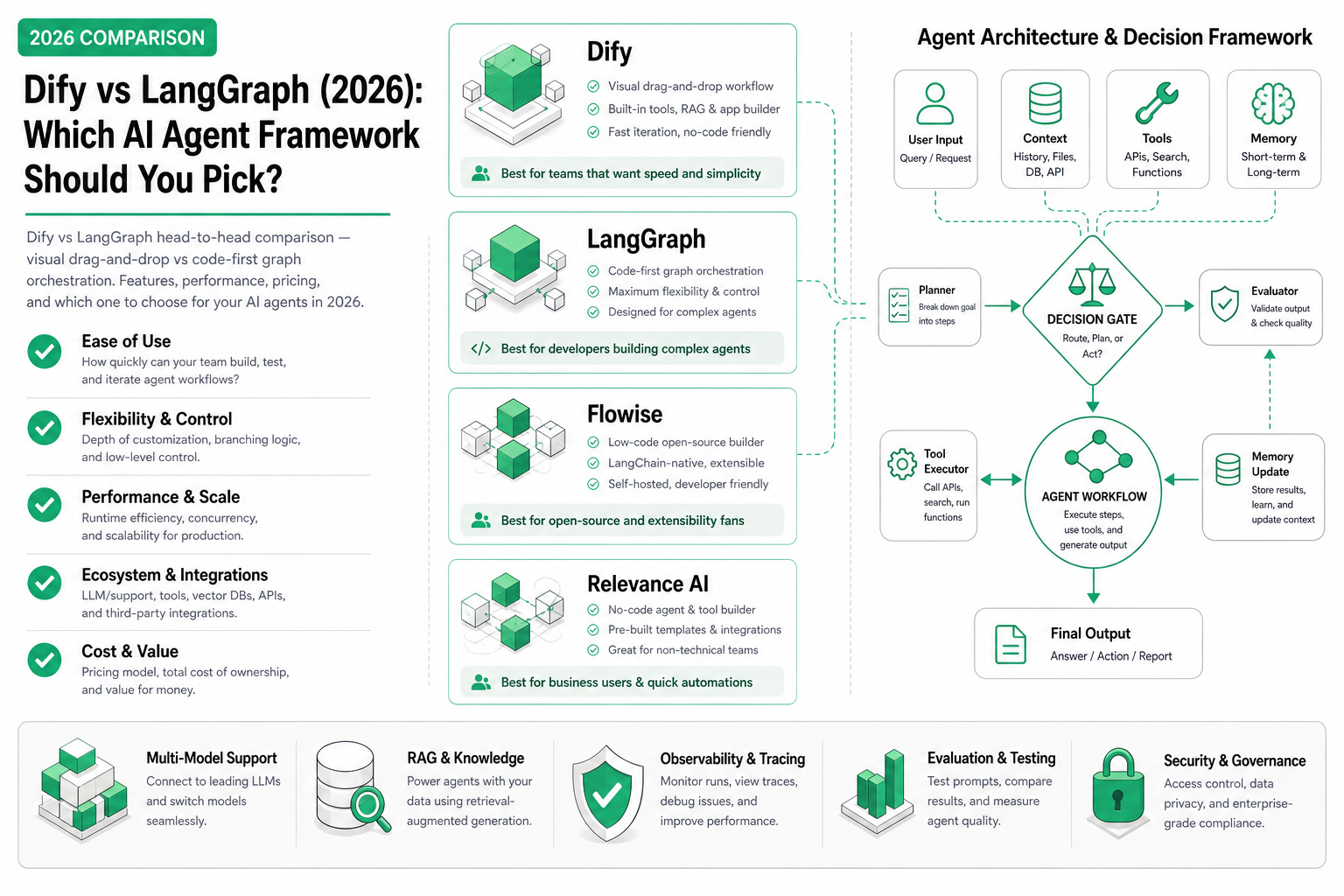
TL;DR — Dify and LangGraph sit at the same layer (agent orchestration) but take opposite approaches. Dify is a visual, low-code platform where you build agents on a canvas — best when non-developers need to build or modify workflows and you want fast iteration. LangGraph is a code-first Python/JS library for graph-based orchestration with durable state — best when you need fine-grained control, complex branching, and production-grade persistence. Choose by who builds your agents and how much control you need.
These two come up constantly as alternatives, but they’re not really competing for the same job. The honest framing: it’s not “which is better,” it’s “who is building, and how much control do you need.” For each tool’s full story see the Dify deep-dive and the LangChain/LangGraph deep-dive.
The fundamental difference
- Dify is a platform. You drag nodes on a canvas, configure each node’s model and prompt in a side panel, and the platform generates and hosts the execution engine. The output is a deployed API endpoint. No code required.
- LangGraph is a library. You write Python (or TypeScript) that defines a graph of nodes and edges with a typed, persistent state object. You own the runtime, the deployment, and every decision.
The same plan-execute-review agent is a three-box canvas in Dify and ~50 lines of graph wiring in LangGraph. Neither is “better” — they trade control for accessibility in opposite directions.
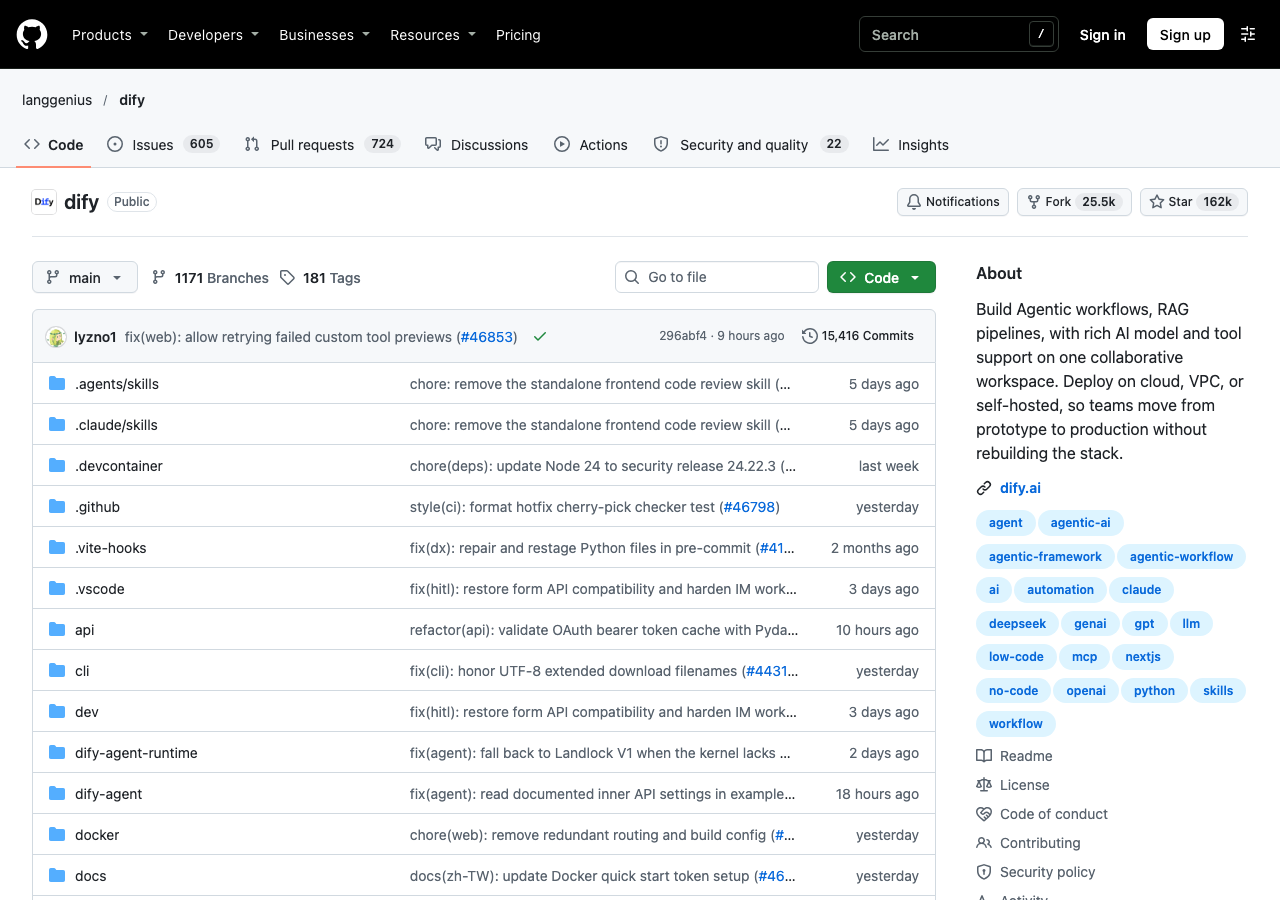 The Dify repository as captured on 2026-11-20 (UTC). Dify ships as a platform you self-host or use as a cloud service.
Head-to-head
| Dimension | Dify | LangGraph |
|---|---|---|
| Paradigm | Visual canvas (low-code) | Code-first graph (Python/JS) |
| Who can build | Non-developers + developers | Developers only |
| Flexibility | Constrained to node types | Unlimited |
| Iteration speed | Fast (visual) | Medium (code) |
| State management | Platform-managed | Explicit, typed, durable checkpoints |
| Branching / loops / retries | Supported, visual | Full control, conditional edges |
| RAG | Built-in, first-class | Via LangChain components |
| Version control | Platform-managed | Native git |
| Deployment | One-click hosted API | You build and deploy it |
| Observability | Built-in trace viewer | LangSmith or custom |
| Production at scale | Workflow engine can bottleneck | Used in production (its README names Klarna, Replit and Elastic) |
| Vendor lock-in | Medium (platform) | Low (open library) |
Which to choose
Pick Dify when:
- Non-technical stakeholders (PMs, domain experts) need to build or edit agent workflows
- You want to prototype an agent concept in 30 minutes
- You need built-in RAG without assembling a vector DB + embedding + retrieval pipeline
- You’re building customer-facing AI apps (support agents, knowledge bases) fast
Pick LangGraph when:
- You need fine-grained control over the agent’s control flow
- Your workflow has complex branching, loops, or multi-agent coordination
- You need durable execution that survives process restarts mid-task
- Your team is developers who want code, git, and full ownership
Use both when a Dify front-of-house agent calls a LangGraph service (via webhook/API) for the parts that need code-level control. They compose cleanly across an API boundary.
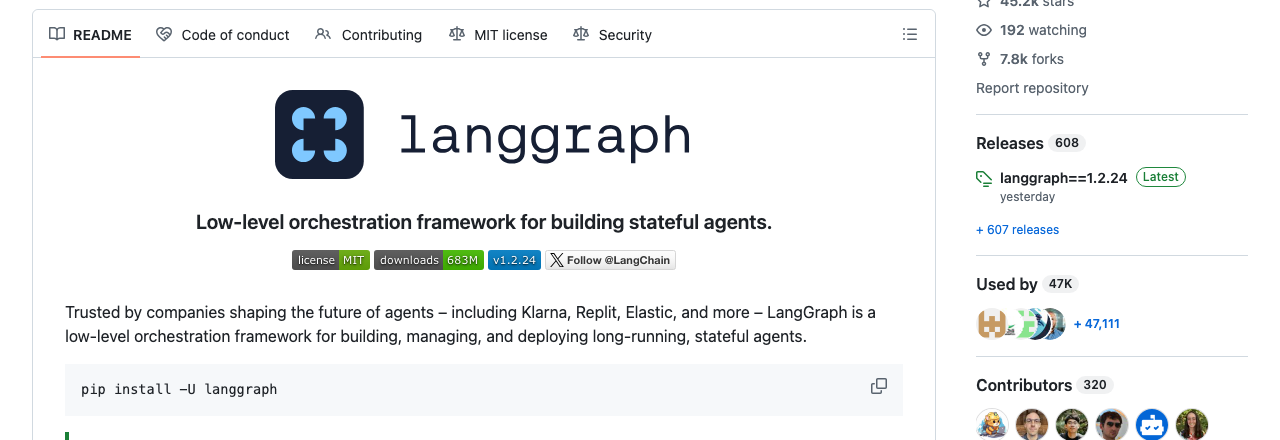 The LangGraph README as captured on 2026-11-20 (UTC). It names Klarna, Replit and Elastic among its users; the article cites only these.
A note on scale
Dify’s biggest production caveat is the workflow engine: under concurrency, the orchestration overhead (state serialization, DB writes per node) can exceed the actual LLM latency, so load-test a self-hosted deployment at your expected concurrency before relying on it. LangGraph pushes those concerns onto you (you run the checkpointer, the workers, the scaling) but has no platform ceiling; its README names Klarna, Replit and Elastic among the companies using it. If you expect high QPS, that difference matters.
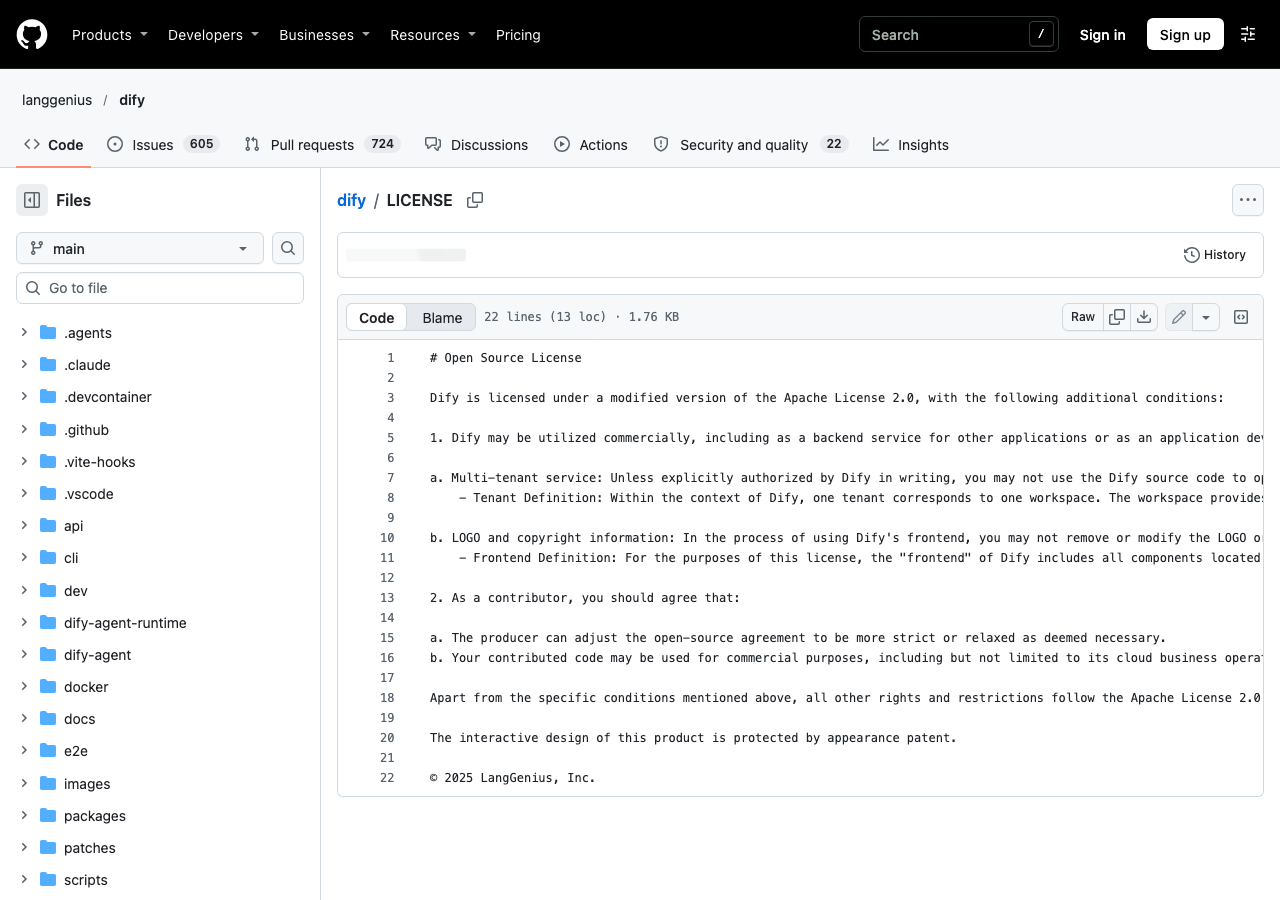 Dify’s LICENSE file as captured on 2026-11-20 (UTC): a modified Apache 2.0 that needs a commercial license for multi-tenant use or for removing the frontend logo.
Where they fit in the stack
Both are the agent-framework layer of the AI agent infrastructure stack. They orchestrate reasoning and call models through whatever gateway or API you configure (for example, both accept an OpenAI-compatible endpoint, so one key on SandBase’s language models can serve Claude, GPT, Gemini or DeepSeek to either) — they sit above the inference and gateway layers, not in place of them. If your team is TypeScript-first, also weigh Mastra as a third option, and if your agent’s value is broad service integration, see n8n vs Dify.
FAQ
Is Dify or LangGraph better for production?
Both run in production, differently. LangGraph is more battle-tested for high-scale, complex agents (its README names Klarna, Replit and Elastic as users) but you own the infrastructure. Dify gets you to production faster with less code, but its workflow engine can bottleneck under high concurrency. Choose by your scale and team.
Can non-developers use LangGraph?
No. LangGraph requires writing Python or TypeScript. If non-developers need to build or modify agent workflows, Dify’s visual canvas is the right tool.
Do Dify and LangGraph compete directly?
They occupy the same layer but serve different builders. Dify targets fast, accessible, low-code agent building; LangGraph targets code-level control and durable orchestration. Many teams use Dify for some agents and LangGraph for others.
Can I migrate from Dify to LangGraph later?
There’s no automatic export, but the concepts map: Dify nodes become LangGraph nodes, Dify’s flow becomes your graph edges. Expect to rewrite, not convert. Prototyping in Dify and rebuilding the high-control paths in LangGraph is a common progression.
Which has less vendor lock-in?
LangGraph — it’s an open-source library you run yourself, so there’s no platform dependency. Dify is self-hostable under a modified Apache 2.0 license (running it as a multi-tenant service or removing its branding needs a commercial license, checked November 20, 2026), and your workflows live in its platform format, which is a softer form of lock-in.
New to Dify? Start with our complete Dify platform guide.
Related Reading
- Dify AI Platform Explained: Build AI Agents Visually (2026 Guide)
- LangGraph vs LangChain in 2026: Agent Framework Guide & Comparison
- n8n vs Dify: Which AI Agent Platform (2026)
- 10 Best Open-Source AI Agent Frameworks in 2026 (Ranked)
- AutoGen vs CrewAI: Which Multi-Agent Framework Wins in 2026?
- Mastra Explained: The TypeScript-First AI Agent Framework
Key takeaways
- Dify = visual, low-code, accessible to non-developers, fast to prototype. LangGraph = code-first, maximum control, durable state, developer-only.
- The deciding question is who builds your agents and how much control you need — not raw capability.
- For high concurrency, LangGraph’s no-ceiling model wins; for speed and non-dev access, Dify wins.
- Read the Dify and LangGraph deep-dives, and consider Mastra if you’re TypeScript-first.
Found this useful? Share it