LiteLLM vs OpenRouter: Self-Hosted or Managed?
LiteLLM vs OpenRouter: self-hosted proxy vs managed gateway. Compared on cost, budgets, failover, model coverage and data path, with figures from both vendors' docs.
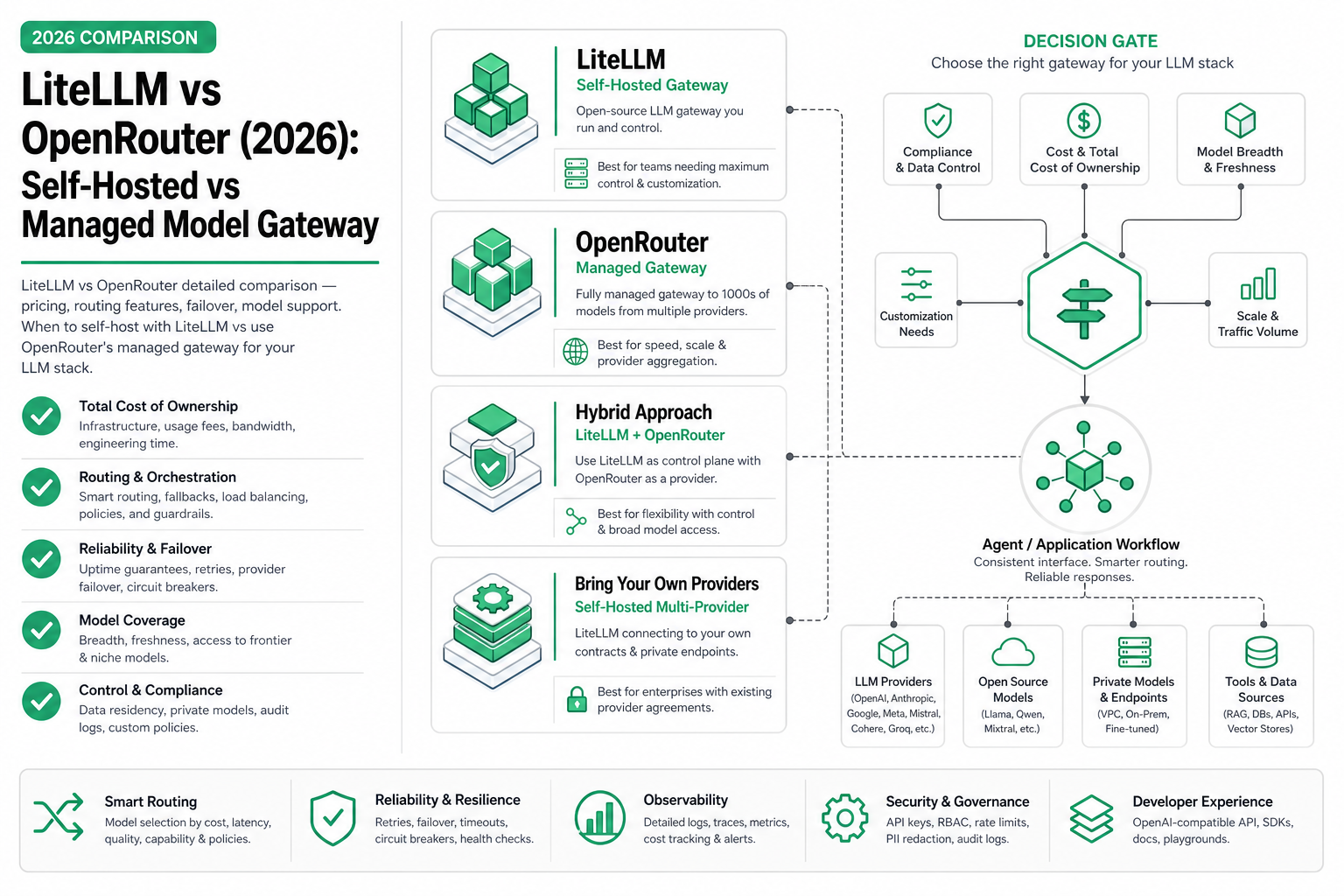
TL;DR — Both give your agents one endpoint for many model providers, but the model is different. LiteLLM is an open-source proxy you self-host — you own the infrastructure, the data path, and the provider keys, and you get budget caps and fine-grained control. OpenRouter is a managed marketplace — zero ops, access to 600+ models from 80+ providers, and unified billing, but requests flow through a third party and you have less control. Pick LiteLLM for control, self-hosting, and budget governance; pick OpenRouter for zero-setup convenience and the widest model catalog.
A model gateway is the layer that gives your agent a single OpenAI-compatible endpoint for many providers, with routing and failover. LiteLLM and OpenRouter both fill that role but make opposite trade-offs on the build-vs-buy axis. For the full picture on the self-hosted option, see the LiteLLM deep-dive.
If you are evaluating managed gateways, multimodal APIs, or policy-focused products beyond these two, start with the broader OpenRouter alternatives comparison.
The fundamental difference: self-hosted vs managed
- LiteLLM is software you run. You deploy the proxy (Docker), configure your own provider keys, and all traffic flows through infrastructure you control. Your code and data never touch a third party. You set budgets, rate limits, and routing rules.
- OpenRouter is a hosted service. You sign up, get one API key, and call 600+ models from 80+ providers through their endpoint. They handle the provider relationships, billing, and uptime. Your requests flow through their servers.
The decision mirrors every build-vs-buy call: control and data-residency vs convenience and zero ops.
Head-to-head
| Dimension | LiteLLM | OpenRouter |
|---|---|---|
| Model | Self-hosted open-source proxy | Managed SaaS marketplace |
| Setup | Deploy + configure (low effort) | Sign up (zero ops) |
| Catalog | 100+ LLMs across providers | 600+ models, 80+ providers |
| Where requests flow | Your infrastructure | OpenRouter’s servers |
| Provider keys | Your own | Theirs (or BYOK) |
| Cost tracking | Built-in, per-key/team | Built-in dashboard |
| Budget caps | Yes: global, team, member, key (needs a database) | Budgets and spend controls on paid plans; per-key credit caps |
| Data residency | Full control | Third-party transit |
| Billing | Per-provider (your accounts) | Unified credits; 5.5% fee when you buy them (Standard) |
| Failover | Retries, cooldowns, ordered and weighted fallbacks you configure | Provider fallback built in; failed attempts are not billed |
| Best fit | Control, governance, self-host | Convenience, widest catalog |
What each one costs
Both tools are cheap to start, and the difference shows up at volume. Figures are from each vendor’s docs, checked 2026-11-22.
- OpenRouter bills inference at the provider’s list price on every plan. It charges a fee when you buy credits: 5.5% on Standard and 8% on Business, so roughly $550 per $10,000 of credits on Standard. With your own provider keys (BYOK), the first $25,000 of list-price inference a month carries no OpenRouter fee and 5% applies above that. Source: OpenRouter pricing.
- LiteLLM is open-source software with no per-token fee. You pay providers directly, plus hosting and the work of running it. Its budget features need a database: LiteLLM’s docs warn that without one, budgets such as
max_budgetdo not cap anything and requests keep being served past the limit. So the choice is a percentage fee against an operations cost. If your credit spend is small, the fee is small. If it is large and you already run services reliably, the fee can exceed the cost of running the proxy.
Which to choose
Pick LiteLLM when:
- You need code and data to stay in your own infrastructure (compliance, privacy)
- You want hard budget caps and per-team/per-agent cost isolation
- You already have provider accounts and want to use your own keys/credits
- You want full control over routing, fallback, and rate-limiting rules
Pick OpenRouter when:
- You want zero infrastructure and instant access to the widest model catalog
- You prefer one unified bill over managing multiple provider accounts
- You’re prototyping or running low enough volume that ops overhead isn’t worth it
- You want to try many models quickly without signing up with each provider
You can also layer them: some teams use OpenRouter as one “provider” behind a self-hosted LiteLLM proxy — LiteLLM for governance and budget caps, OpenRouter for reach into models they don’t have direct accounts with.
Where they fit in the stack
Both are the model-gateway layer of the AI agent infrastructure stack — above the inference engine, below your agent framework. If you self-host open-weight models, LiteLLM sits naturally in front of your own vLLM or SGLang instances alongside cloud providers. OpenRouter is cloud-only by nature — it can’t route to a model running inside your network.
FAQ
Is LiteLLM or OpenRouter cheaper?
It depends on volume. OpenRouter does not mark up inference, but it charges 5.5% when you buy credits on its Standard plan (8% on Business). LiteLLM is free software, so you pay only provider costs plus your hosting and operations. At low volume OpenRouter’s convenience usually wins; at high volume self-hosted LiteLLM with your own provider credits is typically cheaper.
Can I self-host OpenRouter?
No. OpenRouter is a managed SaaS only. If self-hosting is a requirement, LiteLLM (or another self-hosted gateway) is the option.
Does LiteLLM support as many models as OpenRouter?
OpenRouter lists more models (600+ models from 80+ providers) because it runs a marketplace. LiteLLM’s docs say it calls 100+ LLMs through one interface, and you can add OpenRouter itself as one of its providers, effectively combining both catalogs.
Which keeps my data more private?
LiteLLM, when self-hosted — requests flow only through your infrastructure to the providers whose keys you configured. With OpenRouter, requests transit their servers. For strict data-residency or compliance needs, self-hosted LiteLLM is the safer choice.
Can I use both together?
Yes. A common pattern is a self-hosted LiteLLM proxy with OpenRouter configured as one upstream provider — you get LiteLLM’s governance and budget caps plus OpenRouter’s wide model reach.
Related Reading
- Best OpenRouter Alternatives: Managed & Self-Hosted (2026)
- LiteLLM Proxy Explained: Route 100+ LLM Models via One API (2026)
- vLLM vs SGLang: Which Inference Engine for Agents (2026)
- LLM API Pricing in 2026: The Complete Guide
- AI Agent Infrastructure Stack 2026
- Per-Call vs Token Pricing: Which Works for Agents
- Best Models for Autonomous Agents (2026)
Key takeaways
- LiteLLM = self-hosted, open-source, maximum control and data privacy, hard budget caps. OpenRouter = managed, zero-ops, widest catalog, unified billing.
- The choice is build-vs-buy: control and compliance (LiteLLM) vs convenience and reach (OpenRouter).
- They compose — OpenRouter can be one provider behind a LiteLLM proxy.
- Only LiteLLM can front self-hosted models like vLLM or SGLang; OpenRouter is cloud-only. See the LiteLLM deep-dive for the full setup.
Found this useful? Share it