DeepSeek Harness vs Hermes Agent (2026): OpenClaw Comparison
DeepSeek Harness vs Hermes Agent, with OpenClaw compared: architecture, setup, extensibility, channels, learning loops, and which open-source AI agent fits each use case in 2026.
TL;DR: Three open-source agent frameworks, three completely different bets. DeepSeek Harness bets on plugin composability — every piece replaceable. OpenClaw bets on accessibility — talk to your agent from WhatsApp. Hermes Agent bets on learning — the agent compounds knowledge over time. All MIT-licensed, all self-hosted. Pick based on what problem you’re actually solving.
The short answer: DeepSeek Harness vs Hermes vs OpenClaw
If you need a usable personal assistant today, choose OpenClaw. If recurring work should improve through memory and extracted skills, choose Hermes Agent. If you are assembling a custom runtime and need every model, tool, storage, and loop to remain replaceable, choose DeepSeek Harness—but treat it as a developer preview, not a production-ready product. This is the practical answer to “DeepSeek Harness vs Hermes Agent” and “DeepSeek Harness vs OpenClaw”; the table below explains the trade-offs.
For the DSH installation boundary and current release caveats, see our DeepSeek Harness developer preview guide. For the plugin architecture itself, see DSH Capability Seams.
They’re Not Competing — They’re Solving Different Problems
The lazy take is “which one is best.” The honest take: these three aren’t interchangeable options on the same spectrum. They occupy different design spaces entirely.
- DeepSeek Harness is an infrastructure framework — you assemble your own agent from composable plugins.
- OpenClaw is a personal agent gateway — you deploy once and talk to it from everywhere.
- Hermes Agent is a learning runtime — it compounds knowledge and gets faster at recurring work.
If you’re choosing between them, you’ve already misunderstood the landscape. Most teams will eventually use ideas from all three. The question is: which architecture matches your immediate need?
Quick Comparison
| DeepSeek Harness | OpenClaw | Hermes Agent | |
|---|---|---|---|
| Developer | DeepSeek AI | Community (Peter Steinberger) | Nous Research |
| GitHub Stars | 18.5k | 250k+ | 61k+ |
| Language | TypeScript | TypeScript | Python |
| License | MIT | MIT | MIT |
| Core Idea | Everything is a plugin | Multi-channel personal agent | Self-improving loop |
| Architecture | Cordis meta-framework | Gateway → Agent Runner pipeline | Five-pillar (Memory, Skills, Soul, Crons, Learning) |
| Maturity | Developer preview (v0.1) | Production | Production |
| Model Support | Any (plugin) | Any (OpenAI-compatible) | Any (OpenAI-compatible) |
| Learning | No built-in | No built-in | Skill extraction + memory |
| Multi-channel | No built-in (plugin possible) | 10+ platforms built-in | Terminal + messaging |
| Scheduling | Plugin | Via integrations | Built-in cron system |
| Extensibility | Hot-reload plugins, no fork needed | Fork + adapters | Fork + custom skills |
Architecture Deep Dive
DeepSeek Harness: The Empty Framework
DSH’s radical claim is that the framework itself contains almost nothing. The runtime (dsh) is just Cordis — a plugin loader that manages dependencies and lifecycle. Every actual capability is a plugin:
┌─────────────────────────────────────────────┐
│  Cordis Runtime (load/unload, dependencies) │
├─────────────────────────────────────────────┤
│  Model Plugin  │  Tool Plugins  │  UI Plugin │
│  Session Store │  Sandbox       │  Loop/Sched│
│  Storage       │  Skills        │  Telemetry │
└─────────────────────────────────────────────┘
Want Redis sessions? Write a session plugin. Want a Docker sandbox? Write a sandbox plugin. Want a different agent loop pattern? Write a loop plugin. You never fork DSH itself.
The trade-off is clear: maximum flexibility, maximum assembly required. Out of the box, DSH does nothing until you configure which plugins to load. The four built-in modes (Standard, PTC, Minimal, Creative) are just pre-configured plugin sets.
For a full breakdown, see our DeepSeek Harness deep-dive.
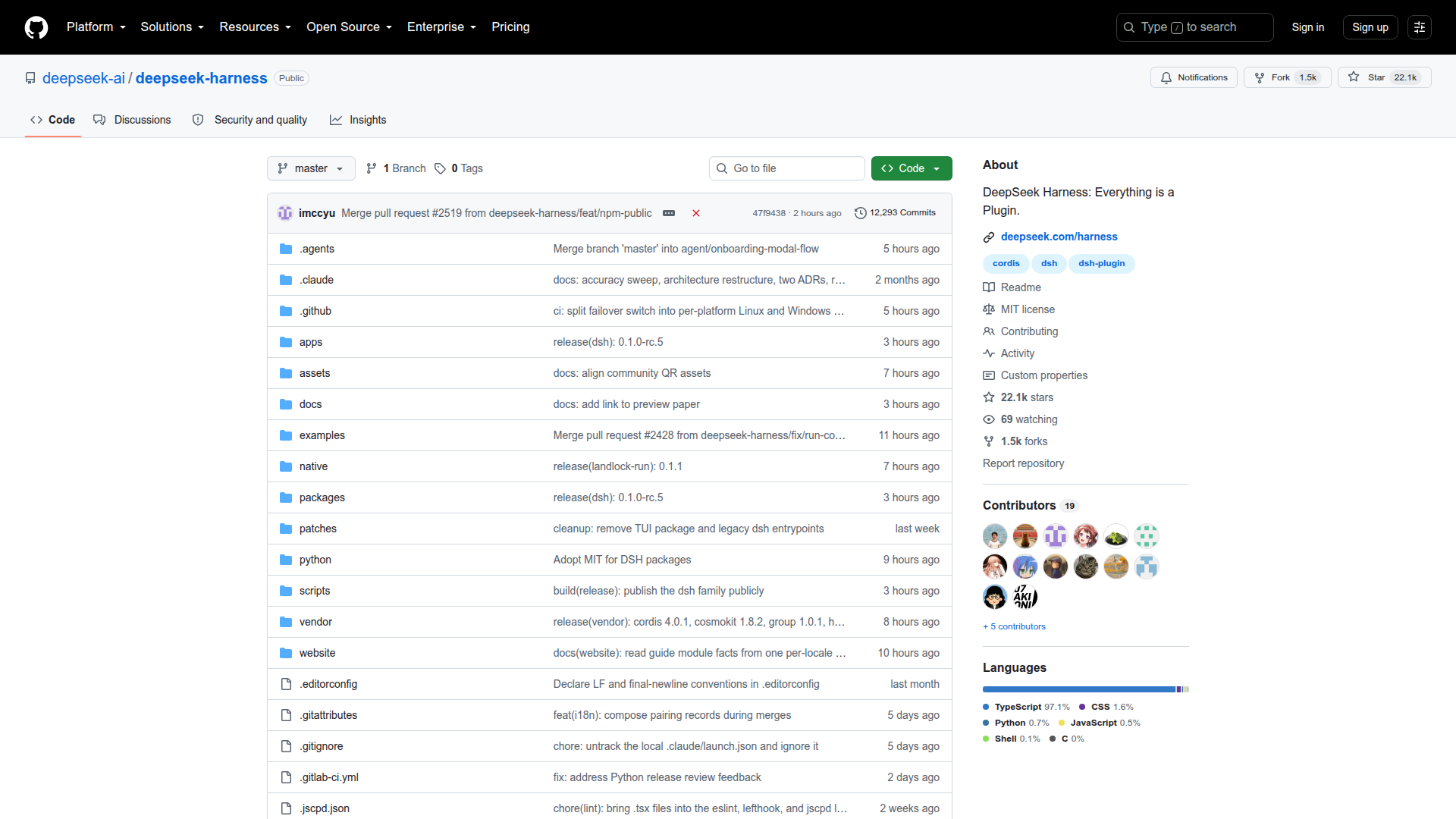 DeepSeek Harness — 18.5k stars, MIT license, plugin-everything architecture.
OpenClaw: The Multi-Channel Gateway
OpenClaw’s architecture is a three-layer pipeline optimized for one thing: letting you talk to an agent from any platform.
┌─────────────────────────────────────────────┐
│  Channel Layer (WhatsApp, Slack, Telegram,  │
│  Discord, Signal, iMessage, Teams, Matrix)  │
├─────────────────────────────────────────────┤
│  Gateway Server (auth, routing, queueing)   │
├─────────────────────────────────────────────┤
│  Agent Runner (context, model, agentic loop)│
└─────────────────────────────────────────────┘
The gateway normalizes messages from 10+ platforms into a common format before the agent sees them. The agent doesn’t know or care if you’re messaging from Telegram or Slack. Identity and personality live in SOUL.md; memory uses layered Markdown files.
The trade-off: OpenClaw is opinionated about its pipeline. You can add channel adapters, but you can’t easily swap the fundamental gateway-runner architecture without forking. It’s a product, not a toolkit.
For the architecture internals, see Inside OpenClaw: The Architecture That Hit 250K Stars.
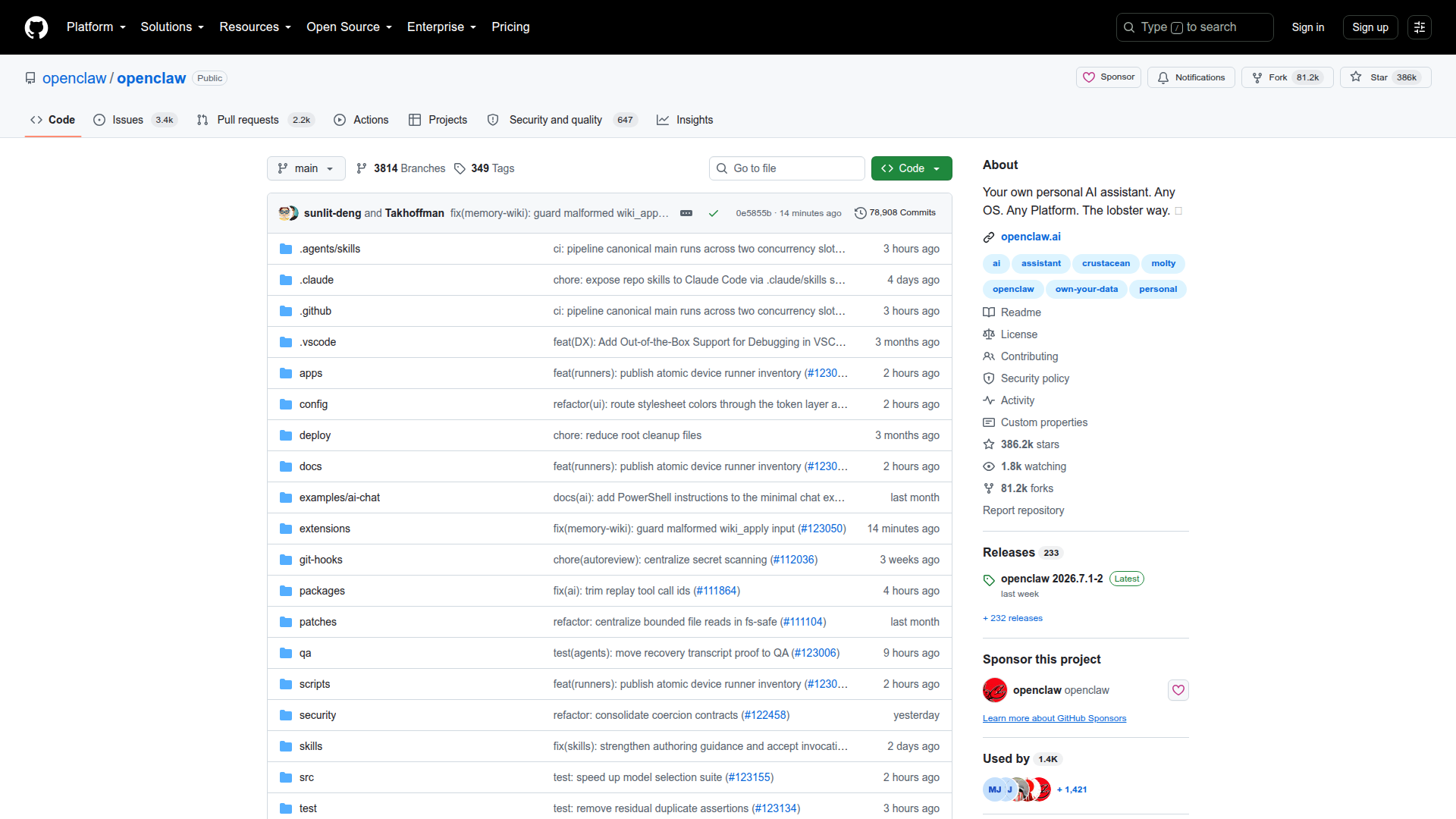 OpenClaw — 250k+ stars, the fastest-growing open-source agent project in history.
Hermes Agent: The Learning Machine
Hermes is built around the idea that an agent should get better over time without you changing its code. Three mechanisms drive this:
┌─────────────────────────────────────────────┐
│  Task Execution                             │
├──────────────┬──────────────┬───────────────┤
│  Skill Docs  │  Memory      │  Nudge System │
│  (procedures │  (user.md +  │  (self-prompt │
│  from past   │  memory.md)  │  to persist   │
│  successes)  │              │  learnings)   │
├──────────────┴──────────────┴───────────────┤
│  Cron Scheduler (offline work)              │
└─────────────────────────────────────────────┘
When Hermes solves a hard problem, the nudge system prompts it to write a skill document. Next time a similar task appears, that skill loads into context — the agent doesn’t re-derive the solution. Community benchmarks show ~40% task-time reduction on recurring work.
The trade-off: the learning advantage is zero on day one. It takes weeks of use before the skill library compounds meaningfully. And the quality of skills depends heavily on the underlying model — weak models write vague, useless skills.
Details in How Hermes’ Self-Improving Loop Works.
 Nous Research — the team behind Hermes Agent’s self-improving architecture.
The Real Differences That Matter
1. What Happens Day One vs Day Ninety
| Time Horizon | DeepSeek Harness | OpenClaw | Hermes Agent |
|---|---|---|---|
| Day 1 | High setup cost (choose plugins, configure) | Works immediately (install, connect channels) | Works immediately but no advantage yet |
| Day 30 | Custom pipeline tuned to your workflow | Familiar assistant across all platforms | Skills library starting to compound |
| Day 90 | Mature plugin ecosystem (maybe) | Same as day 30 | Measurably faster at recurring tasks |
2. Who Should Use What
Choose DeepSeek Harness if:
- You’re building a custom agent product, not using one off-the-shelf
- You need to swap every component (model, sandbox, storage, loop)
- You want to contribute to an ecosystem of composable plugins
- You’re comfortable with a preview-stage project that will break
Choose OpenClaw if:
- You want a personal agent accessible from your phone
- Multi-platform presence matters (team Slack + personal Telegram + WhatsApp)
- You value a batteries-included product over a toolkit
- Coding is one of many things you want your agent to do
Choose Hermes Agent if:
- Your work is repetitive (same codebase, same deployment targets, same research patterns)
- You want the agent to get faster over time without manual intervention
- Background scheduling (cron jobs while you sleep) matters to your workflow
- You’re Python-native and prefer that ecosystem
3. Can You Combine Them?
In theory, yes. The architectures aren’t mutually exclusive:
- Hermes skills inside DSH: Write a DSH plugin that implements Hermes-style skill extraction and memory. DSH’s plugin architecture makes this feasible without forking either project.
- OpenClaw channels for DSH: Build a DSH UI plugin that acts as an OpenClaw-style multi-channel gateway. The agent logic stays in DSH; the channel layer is just another plugin.
- DSH as OpenClaw’s backend: OpenClaw’s Agent Runner could theoretically be replaced with a DSH instance, gaining plugin composability while keeping OpenClaw’s channel layer.
None of these integrations exist today, but the architectural compatibility is there.
Benchmark Relevance
| Benchmark | DeepSeek Harness | OpenClaw | Hermes Agent |
|---|---|---|---|
| SWE-bench | Depends on model plugin | Not benchmarked (not coding-first) | Not benchmarked directly |
| Terminal-Bench | Minimal mode designed for this | N/A | N/A |
| Task-time reduction (recurring) | N/A | N/A | ~40% (community measured) |
DSH’s Minimal mode (shell + file edit only) is explicitly designed for clean benchmark evaluation. Neither OpenClaw nor Hermes targets coding benchmarks — they’re general-purpose agents.
Ecosystem & Community
| DeepSeek Harness | OpenClaw | Hermes Agent | |
|---|---|---|---|
| Community | Discord + GitHub Discussions | Discord + GitHub | Discord + GitHub |
| Plugin/Extension count | Minimal (just launched) | 10+ channel adapters | Growing skill library |
| Documentation | Architecture docs, sparse guides | Good docs, active community | Solid docs |
| Corporate backing | DeepSeek AI | Community-driven | Nous Research |
| Contribution model | dsh-plugin topic | Fork + PR | Fork + PR |
FAQ
Which one is most production-ready?
OpenClaw and Hermes are both production-ready. DeepSeek Harness is explicitly a developer preview (v0.1) with guaranteed breaking changes. Don’t ship DSH to production yet.
Can I use all three with SandBase?
Yes. All three support OpenAI-compatible API endpoints. Point any of them at https://api.sandbase.ai/v1 with your API key and you get access to 300+ models. For one route across LLM, image, and video capabilities, see our unified AI API guide and video-generation API comparison.
Which is best for a coding agent?
None of these are coding-first. For coding specifically, look at Claude Code, Codex CLI, or OpenHands. These three are general-purpose agent frameworks with different architectural philosophies. See our Claude Code vs Codex vs OpenClaw comparison for the coding angle.
If you are building the runtime rather than choosing a harness, continue with our Claude Agent SDK guide and GitHub MCP Server security guide. They cover the tool permissions and repository boundary that a production agent still needs after model selection.
Will DeepSeek Harness catch up on stars?
Stars don’t equal utility. DSH launched with 18.5k stars and will likely grow fast given DeepSeek’s brand. But OpenClaw’s 250k stars reflect a product people use daily, not just star. The real question is whether DSH’s plugin ecosystem materializes — that’s what determines its long-term value.
Is there a winner?
No. Different tools for different jobs. If forced to pick one: OpenClaw if you want something useful today, Hermes if you have recurring workflows, DSH if you’re building custom agent infrastructure and can tolerate preview instability.
For the engineering foundations behind these systems, see our guides to agent harness performance, agent observability and tracing, the portable Agent Plugins standard, and vLLM vs SGLang inference engines.
Try DeepSeek V4 on SandBase: DeepSeek V4 Pro | DeepSeek V4 Flash