Wan 3.0 Is 40% Off on SandBase: Price, Features, and Real Tests
Wan 3.0 is 40% off on SandBase as of 17 Nov 2026. Default 5s 720p is From $0.30. October tests billed $0.325 and $1.95 under the earlier 35% offer.
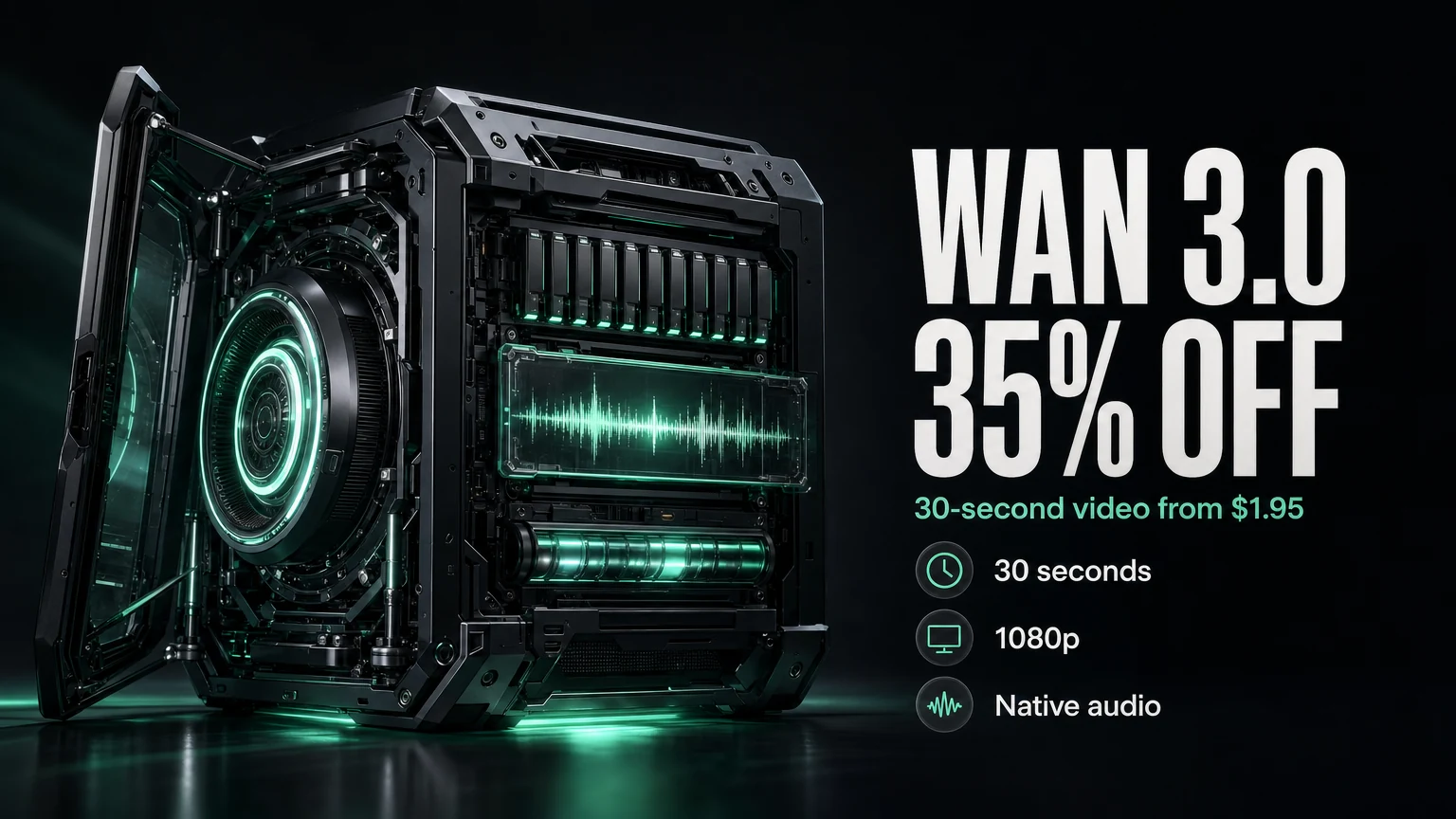
The number that still matters from the October test is $1.95: what our 30-second Wan 3.0 clip was billed on 28 October, under the 35% offer live that day. On 17 November 2026, Asia/Shanghai, the catalog is a different offer. The hub and cards show 40% off, and the default 5-second 720p text-to-video hero is From $0.30, against a $0.50 list row.
This guide explains the Wan 3.0 discount on SandBase, what Alibaba’s model can actually generate, and where its low price comes with a trade-off. It is for developers choosing a video API for ads, product clips, storyboards, or agent workflows. Current catalog figures were checked on 17 November 2026, Asia/Shanghai. The billed test amounts below stay dated to the October runs.
Key takeaway
- As of 17 November 2026, Asia/Shanghai, SandBase shows 40% off on Wan 3.0. The default 5-second, 720p text-to-video hero is From $0.30, which is 40% off the $0.50 list row.
- The $0.325 (5-second) and $1.95 (30-second) figures later in this guide are what our October test clips were billed under the earlier 35% offer. They are not today’s catalog prices.
- Applied uniformly to the printed list rates, 40% off is $0.03 / $0.06 / $0.12 per second. A 30-second clip is then $0.90 at 480p, $1.80 at 720p, or $3.60 at 1080p. Prime’s default hero is From $0.42.
- Wan 3.0 generates 2–30 second clips at 480p, 720p, or 1080p, at 30 fps, with optional native audio. SandBase has also listed Pro and Pro Prime cards that, on the cards, upscale with FlashVSR. Official docs still list
wan3.0-videoandwan3.0-video-primeat 480/720/1080.- Treat the discount as a good time to test, not a permanent production assumption. Budget against list price. The hub print checked 17 November says 40% off through 31 December 2026.
Update (17 Nov 2026): The SandBase Wan 3.0 catalog promotion is now 40% off, not the 35% off we recorded on 28 October. The live hub and cards show From $0.30 for the default 5-second 720p text-to-video call (40% off the $0.50 list row). The $0.325 and $1.95 figures below are what our 28 October test clips were billed under the earlier offer; they are not today’s catalog prices. SandBase has also listed Wan 3.0 Pro and Pro Prime endpoints that, on the cards, upscale with FlashVSR to 1080p, 2K, or 4K. Official Model Studio docs on 17 November still only list
wan3.0-videoandwan3.0-video-primeat 480p, 720p, and 1080p. The Pro listings, and what official pages do not say, are in Wan 3.0 Pro on SandBase: 2K and 4K Endpoints, and What Official Docs Do Not Say.
What 40% off means, and what the October test billed
SandBase now writes the offer as 40% OFF. You pay 60% of list. The slug wan-3-0-65-percent-off-guide-2026 was named when the offer was 35% off, which meant you paid 65% of list. It does not mean a 65% discount, and it does not describe today’s 40% off.
The October homepage screenshot still shows the earlier badge:
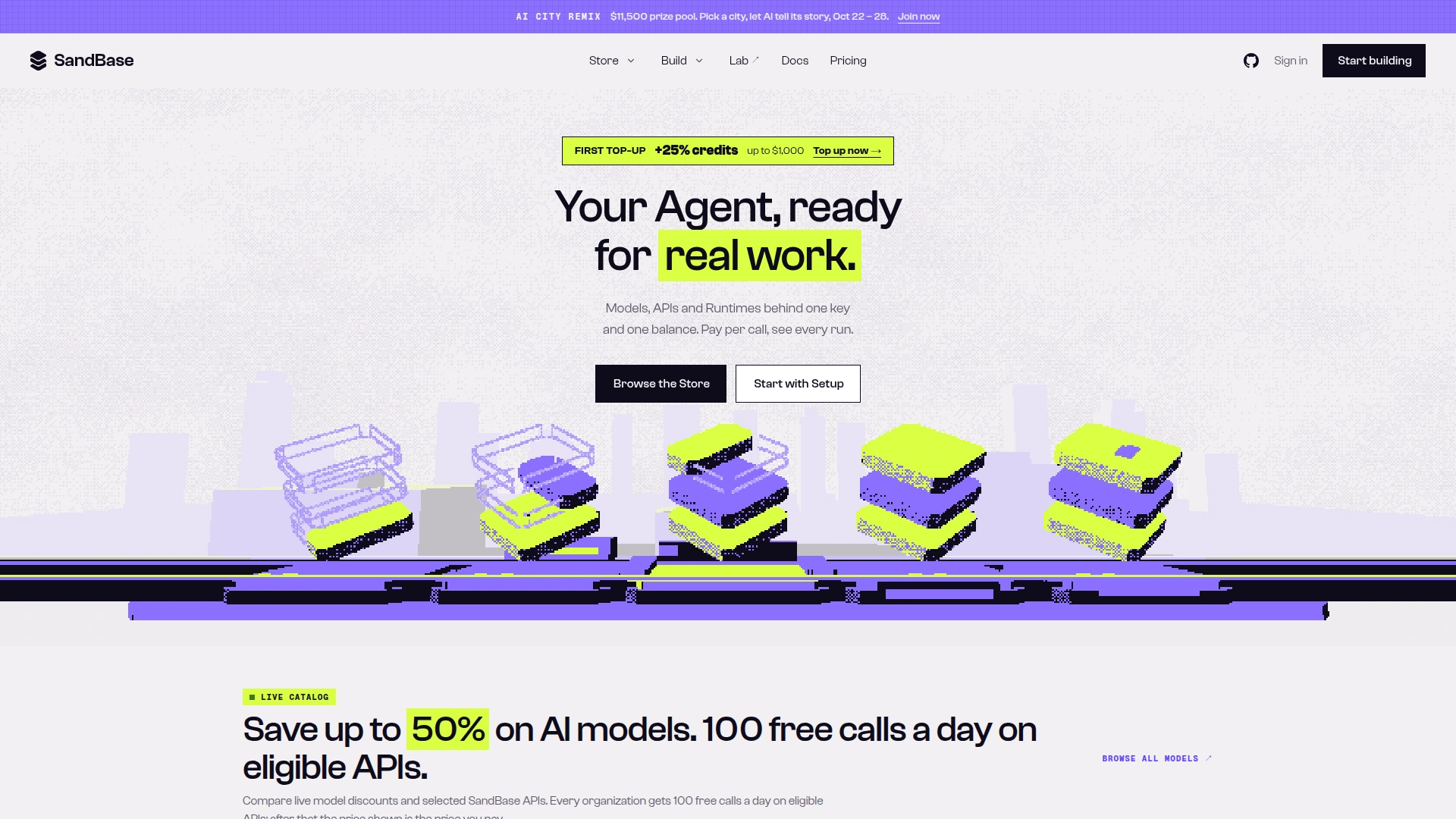 SandBase homepage, captured October 28, 2026. Wan 3.0 endpoints show 35% OFF. The text-to-video default is $0.325 per call against a crossed-out $0.50. The page’s “save up to 50%” headline refers to the whole catalog, not Wan specifically. This frame is the 28 October offer, not the 17 November catalog.
The “per call” number is the default configuration, not a flat fee for every video. Wan is billed by generated seconds and resolution. The README table is the list rate. The hero is the discounted From line. Using 40% off the list rates the non-Pro card still prints ($0.05 / $0.10 / $0.20 per second), checked 17 November 2026, Asia/Shanghai:
| Output | List price / second | 40% off / second | 5 seconds | 30 seconds |
|---|---|---|---|---|
| 480p | $0.05 | $0.03 | $0.15 | $0.90 |
| 720p | $0.10 | $0.06 | $0.30 | $1.80 |
| 1080p | $0.20 | $0.12 | $0.60 | $3.60 |
The arithmetic for the discounted column is seconds × list rate × 0.60. The hero From $0.30 is 40% off the $0.50 list row for the default 5-second 720p call. Prime’s hero is From $0.42, which is 40% off the $0.70 list row for that same default. Prime list rates are $0.068 / $0.14 / $0.28 per second. Audio can be enabled without changing these Standard rates on the SandBase schema we checked. Reference inputs do not turn the request into token billing; duration and resolution still dominate the cost.
Our October clips were billed under the earlier 35% offer: $0.325 for the 5-second 720p clip ($0.50 × 0.65) and $1.95 for the 30-second 720p clip ($3.00 × 0.65). Those bills are historical. They are not the catalog column above.
Alibaba’s own international launch promotion offered 30% off Standard through September 24, 2026, and that offer has ended. The 40% on the SandBase hub on 17 November is a SandBase catalog promotion. They are separate offers with separate dates.
SandBase has also listed Wan 3.0 Pro and Pro Prime cards. On those cards, Pro runs the same Wan 3.0 model and then upscales with FlashVSR to 1080p, 2K, or 4K. That sentence is SandBase catalog text, not an official Alibaba launch. Official IDs on the international Model Studio pages checked 17 November remain wan3.0-video and wan3.0-video-prime at 480p, 720p, and 1080p. China-console-only pages were not audited. The listings, and what those official pages do not say, are in Wan 3.0 Pro on SandBase.
What Wan 3.0 is
Wan 3.0 Text to Video on SandBase is Alibaba Cloud’s hosted video-generation model. Alibaba opened the API generally on August 24, 2026 after an earlier beta. Its main change over the preceding Wan video generation model is native generation up to 30 seconds—twice the previous 15-second ceiling—plus a single “omni” input system for text, images, video, audio, documents, and web pages.
Alibaba describes five production modes: text-to-video, image-to-video, reference-to-video, video editing, and extension. SandBase exposes those as separate endpoints, along with Prime variants tuned for faster inference.
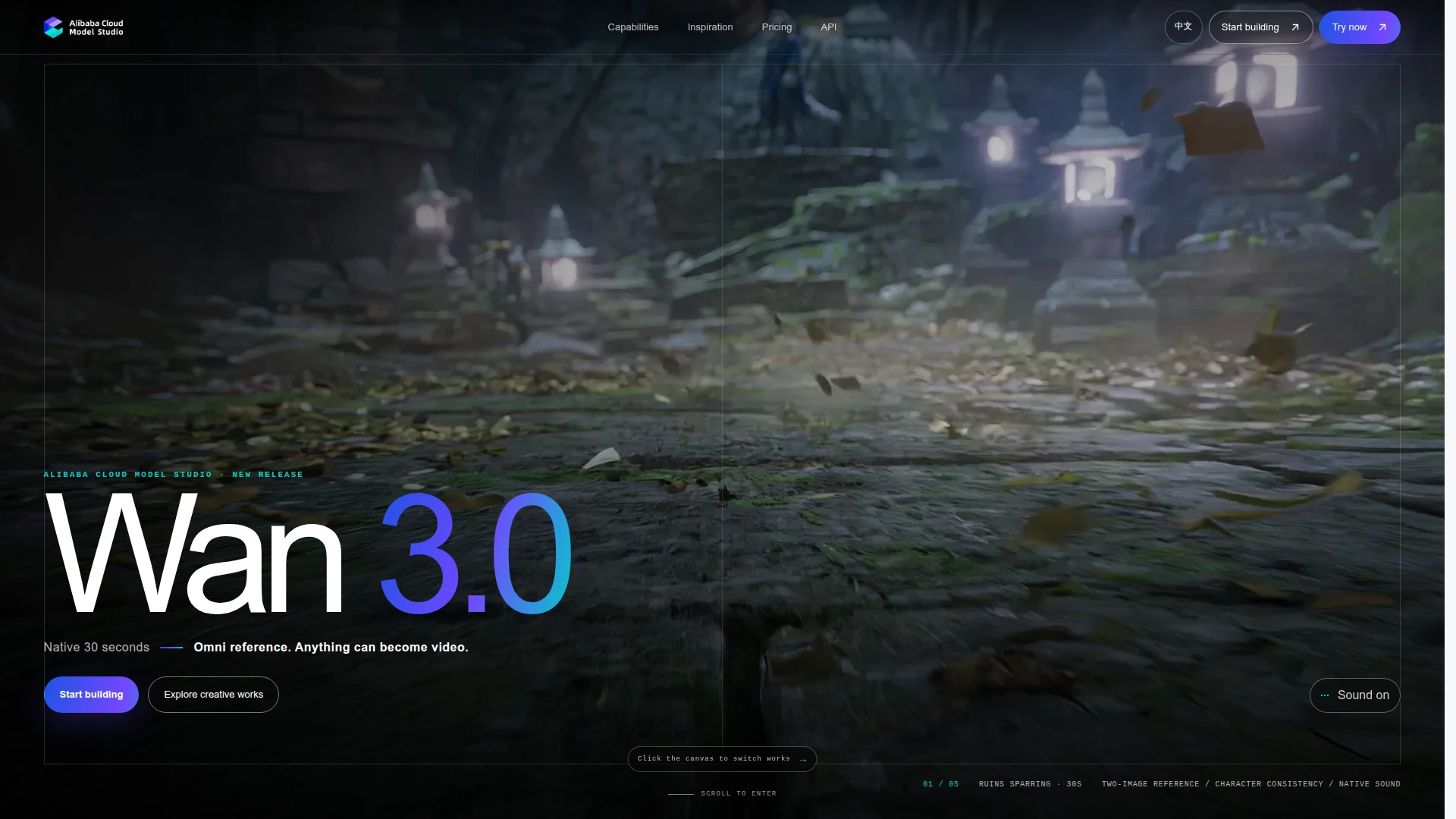 Alibaba Cloud’s official Wan 3.0 release page, captured October 28, 2026. The provider claims native 30-second storytelling, 1080p output, and audio-video generation. These are provider specifications; output quality still depends on the prompt and seed.
The practical spec sheet
| Field | Wan 3.0 Standard on SandBase |
|---|---|
| Provider | Alibaba Cloud |
| Release | Beta August 7, API generally available August 24, 2026 |
| Modalities in | Text; endpoint-dependent image, video, audio, and references |
| Output | Video, optional native audio |
| Duration | 2–30 seconds, or auto |
| Resolution | 480p, 720p, 1080p |
| Frame rate | 30 fps in Alibaba’s API documentation and our outputs |
| Aspect ratios | 16:9, 9:16, 1:1, 4:3, 3:4, 21:9 |
| Controls | Seed, audio toggle; first/last frame and reference controls on matching endpoints |
| Self-hosting | No Wan 3.0 weights or self-hosting license published as of October 28 |
That last row is easy to miss. Alibaba maintains a public Wan 3.0 repository with documentation and demos, but it has not released Wan 3.0 model weights. The hosted API is not the same thing as an open-weight release. Wan 2.2 remains the latest downloadable Wan generation listed in Alibaba’s open repositories at the time of writing.
What is genuinely new
One request can carry a complete 30-second beat sheet
Thirty seconds changes the kind of prompt worth writing. A five-second prompt can describe one action. A 30-second prompt can specify four timed beats, a continuous camera path, and a destination.
Alibaba says Wan can generate the full duration in one pass rather than stitching short clips. Our test supports the narrow version of that claim: ffmpeg’s scene detector found zero cuts in one 30.00-second output. It opened at a night-market wok, moved behind the cook, handed a bowl to a woman in green, and followed her into the crowd.
 Frames from our Wan 3.0 30-second, 720p call on October 23, 2026. The hand-off occurs around 22.5–24 seconds. This strip is re-published from our own test evidence for the same-prompt model comparison, not an Alibaba demo.
The catch was timing. The prompt asked the camera to move behind the cook during seconds 8–16 and complete the hand-off during 16–24. Wan reached both near the end of their windows. Kling 4.0 hit the same beats earlier and more precisely, but cost $4.71 against Wan’s billed $1.95 in that 23 October run, under the 35% offer. Wan is the budget long-take choice, not automatically the best director.
Reference material is broader than a start image
Alibaba’s direct API accepts up to 20 reference assets: up to 10 images, five videos, and five audio files. Documents and web pages can also be used through Alibaba’s “omni creation” surface. That makes Wan 3.0 more interesting for product and character work than a plain text-to-video endpoint.
The SandBase catalog separates the workflows so the schema remains explicit:
alibaba/wan/3.0/text-to-videofor a prompt-only clip;alibaba/wan/3.0/image-to-videofor a first frame or first/last frame;alibaba/wan/3.0/reference-to-videofor identity and style references;alibaba/wan/3.0/video-editfor instruction-based edits;alibaba/wan/3.0/video-extendfor continuation;- the same routes under
/prime/when latency matters more than price.
Do not assume every control from Alibaba’s consumer interface maps one-to-one to every API route. Inspect the endpoint schema before building a form around it.
Audio is generated with the picture
Wan can create dialogue, ambient sound, music, and effects in the same generation. On SandBase, generate_audio is a switch and does not change the displayed Standard rate. That is useful for social drafts and previs, but “has an audio track” does not prove lip sync, clean speech, or licensing suitability. We disabled audio in the comparison run, so we are not grading it here.
What our earlier tests say about quality
We have run Wan 3.0 in two bounded tests, both through SandBase.
In an eight-model product-clip benchmark, Wan tied Gemini Omni Flash at 23/24 on three prompts. It kept a robot vacuum moving behind chair legs and out the other side without reversing or teleporting. The 5-second job cost $0.50 before this promotion and took a 147-second median across three runs. One oddity: a request marked 720p returned a 1920×1080 file.
In the later action and long-take comparison, a 5-second Wan clip was billed $0.325 under the 35% promotion then in effect and completed in 175 seconds. It produced the requested skateboard ollie but kept a side-tracking camera instead of the requested half orbit. The 30-second output was billed $1.95 and took 854 seconds—over 14 minutes. Neither figure is the 17 November catalog price.
Those six short clips and one long take are evidence, not a leaderboard. They suggest good continuity and low cost, while camera choreography and queue time deserve a test with your own prompts. They do not establish a universal win rate, audio quality, or reliability under production load.
Wan 3.0 versus the alternatives
| Model | Longest single request | 720p list price / sec | What stood out in our tests | Trade-off |
|---|---|---|---|---|
| Wan 3.0 | 30 s | $0.10 list; 17 Nov catalog $0.06; October test billed $0.065 | Cheapest long take; good object continuity | Loose beat timing; slow 30 s job |
| Kling 4.0 | 30 s | $0.157 | Best camera orbit and timed choreography in our run | Higher cost; slow 5 s job |
| Seedance 2.5 | 30 s | $0.36 | Draft-to-final workflow | Much higher 1080p price |
| Veo 3.1 | 8 s | $0.20 without audio | Fastest in our action run; 4K option | Cannot make a 30 s clip in one request |
Choose Wan when the shot benefits from 15–30 seconds of continuity and you can tolerate a slower queue. Choose Kling when precise camera movement and timed beats matter more than cost. Choose Seedance when the draft-to-final workflow saves expensive rerolls. Choose Veo for short shots where response time or 4K is the deciding constraint.
A minimal SandBase request
SandBase uses one asynchronous route across video providers. Submit the job, keep the returned run ID, and poll it until the provider finishes:
curl https://api.sandbase.ai/v1/run \
  -H "Authorization: Bearer $SANDBASE_API_KEY" \
  -H "Content-Type: application/json" \
  -d '{
    "model": "alibaba/wan/3.0/text-to-video",
    "prompt": "One continuous handheld take through a night market...",
    "duration": 5,
    "resolution": "720p",
    "aspect_ratio": "16:9",
    "generate_audio": true
  }'
The submission response contains an ID. Poll GET /v1/run/{id} and read the finished media URL from outputs[0].url. Save the run ID alongside the prompt, seed, settings, elapsed time, and charge. Without that record, a later “the model got worse” report is impossible to audit.
Who should use the discount
The promotion is most useful for three workloads:
- A prompt evaluation set. At From $0.30 per 5-second 720p clip on the 17 November catalog, 20 prompts cost $6.00 before rerolls. The October test rate was $0.325. Either way, that is enough to test products, people, text, motion, and failure cases without pretending one showcase clip represents the model.
- Long-take storyboards. Ten 30-second 720p drafts cost $18.00 at 40% off versus $30 list. Our 23 October 30-second clip was billed $1.95 under the earlier 35% offer. Use drafts to validate pacing before paying for 1080p finals.
- Reference-workflow prototypes. Test image, reference, and edit endpoints under the same key, then decide which controls your production UI actually needs.
Do not switch only because of the badge if your product needs sub-minute turnaround. Our 30-second call took 14 minutes. Prime exists for faster inference. On 17 November its default hero is From $0.42 versus From $0.30 on Standard. The October discounted bases were $0.455 versus $0.325. Measure the latency gap on your account before paying the higher tier on every request.
FAQ
Is Wan 3.0 65% off?
No. The slug dates from a 35% off offer, which meant you paid 65% of list. On 17 November 2026 the catalog is 40% off, which means you pay 60% of list. It is not a 65% discount.
How much is a 30-second Wan 3.0 video?
On the 17 November 2026 catalog, 40% off the printed list rates: $0.90 at 480p, $1.80 at 720p, or $3.60 at 1080p. List prices are $1.50, $3, and $6. Our 28 October 30-second 720p test was billed $1.95 under the earlier 35% offer.
Does Wan 3.0 generate audio?
Yes. Alibaba documents native dialogue, music, ambient sound, and effects. SandBase exposes an audio toggle on the text-to-video endpoint.
Can Wan 3.0 run locally?
Not from official Wan 3.0 weights as of October 28, 2026; Alibaba has not published them. Use a hosted API, or choose an earlier open-weight Wan release for self-hosting.
Is the discount permanent?
The hub captured 17 November 2026 prints 40% off through 31 December 2026. Recheck the Wan 3.0 hub before you budget past that date.
Bottom line
The October test still has a concrete bill: a 30-second, 720p single take was billed $1.95 under the 35% offer. The catalog on 17 November 2026 is 40% off, From $0.30 for the default 5-second 720p call, against a $0.50 list row. The model kept that October take continuous and completed the story, but it ran late on the middle beats and took more than 14 minutes to return. Use the current promotion to test your own prompt set on Wan 3.0; keep list price and measured latency in the production budget. For the SandBase 2K and 4K cards, and for what official docs still do not say, read Wan 3.0 Pro on SandBase.
Related reading
Found this useful? Share it