MAGI-2 Is on SandBase: 1080p, $0.08 per Second, Three Model IDs
SandBase lists three MAGI-2 cards on 25 Nov 2026. IDs are sandai/magi-2/*, 1080p only, 4–30s. The card formula is $0.08/s; the hero is From $0.40. Vendor magi-2 is a separate route.
Sand AI MAGI-2 is callable on SandBase as three 1080p video cards. Checked 25 November 2026, Asia/Shanghai, the public pages return HTTP 200, the records are enabled, and each card’s billing expression is (params.duration ?? 5) * 0.08. A default 5-second clip lists at $0.40. A 10-second clip lists at $0.80. Send sandai/magi-2/text-to-video, sandai/magi-2/image-to-video, or sandai/magi-2/reference-to-video to POST https://api.sandbase.ai/v1/run. Sand.ai’s own API uses a different id, magi-2, and a different route.
Use the SandBase cards when you already have a SandBase key and you want 1080p output from 4 to 30 seconds. Open Sand.ai’s platform when you need that vendor’s parts request, org-level model enablement, or the top-up notice on their pricing page. This page records the listing, the ids, the price expression, and the documented fields. It does not record a timed generation, an invoice, or a quality score.
Key takeaway
- SandBase model ids, checked 25 November 2026:
sandai/magi-2/text-to-video,sandai/magi-2/image-to-video,sandai/magi-2/reference-to-video. Catalog stamppublished_atis2026-11-25T00:00:00Z(08:00 Asia/Shanghai). The Sand AI catalog shows 3 video models.- Resolution on every card is
1080ponly. Duration is an integer from 4 to 30, default 5, and the help text says the output is billed per second. The card payload formula is(params.duration ?? 5) * 0.08. The visible hero and the playground estimate are $0.40 / From $0.40, which is the 5-second default.- Call
POST https://api.sandbase.ai/v1/run, then pollGET https://api.sandbase.ai/v1/run/{id}untilcompleted,failed, ortimeout. The Run API is the route reference. The text-to-video panel prints the request body.- Sand.ai’s pricing page lists model
magi-2at 1080p and 0.08 USD/s, and says top-up is not supported for the time being. That is the vendor rate and the vendor console. The SandBase $0.08 figure comes from the SandBase card formula, which matches the vendor number on this check.- MAGI-2 Preview is the August 2026 research release (~114B total, ~6B active). The 24 November 2026 Sand.ai research post describes the hosted flagship as 480B total and ~28B active, and says an open-source release is still to follow. SandBase’s three cards are titled MAGI-2. This article does not treat a leaderboard row named MAGI-2 Preview as these cards.
What the SandBase cards show
The three cards share one price expression and one resolution. They do not share one request body.
| SandBase card | Model ID | Visible price | What the card bills |
|---|---|---|---|
| MAGI-2 Text to Video | sandai/magi-2/text-to-video | From $0.40 per run; playground $0.4 at duration 5 | (params.duration ?? 5) * 0.08. 4s $0.32, 5s $0.40, 10s $0.80, 30s $2.40 |
| MAGI-2 Image to Video | sandai/magi-2/image-to-video | Same From $0.40 and $0.4 estimate | Same formula. image is required |
| MAGI-2 Reference to Video | sandai/magi-2/reference-to-video | Same From $0.40 and $0.4 estimate | Same formula. Up to 10 images, 5 videos, 5 audio clips |
The public hero is “From $0.40 per run.” That line is the default-duration quote. It does not print “$0.08 per second.” The per-second figure is price_formula inside each live card: (params.duration ?? 5) * 0.08, with base_price 0.4, publicDiscountPercent 0, and free_quota_eligible false. Five times $0.08 is $0.40, which is the number on the Run button when duration is 5. The help text says “Billed per second” and “Range: 4 to 30.” A 4-second clip is the short end of that range, so the arithmetic on the formula is $0.32. The hero “From $0.40” matches the default of 5 seconds, which is also what the formula uses when duration is omitted.
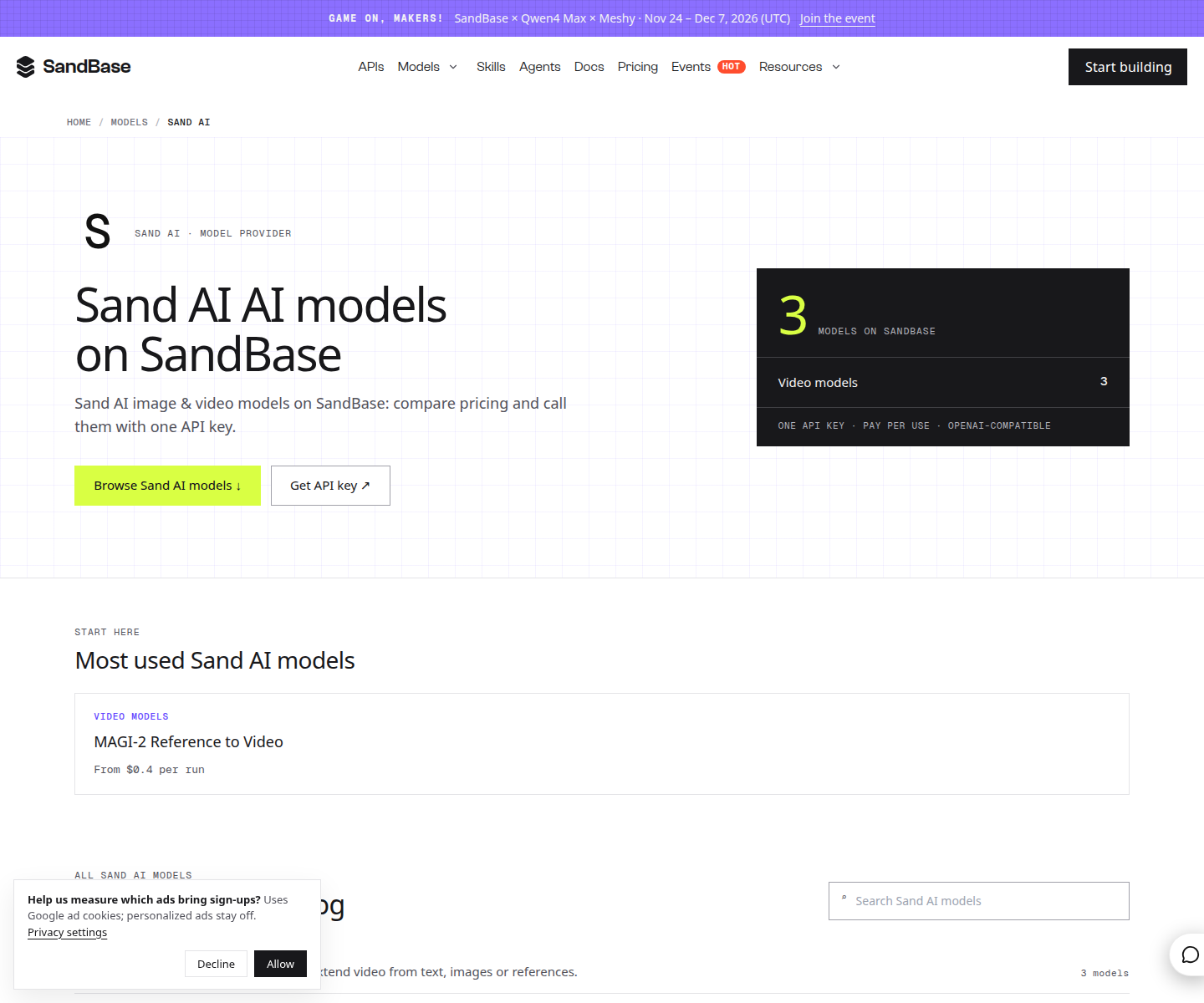
Sand AI catalog at https://www.sandbase.ai/models/sandai, captured 25 November 2026, Asia/Shanghai. The page says 3 video models. The visible “most used” row is MAGI-2 Reference to Video, From $0.4 per run. A cookie prompt covers the lower catalog list.
The formula multiplies output duration only. It has no term for reference video length, reference audio, or generate_audio. The field help says a native audio track is included in the price, and the default is true. This check did not find a cheaper rate for generate_audio: false. It also did not find a sentence that says a failed run is free or billed. Leave failure billing as unknown until a card or an invoice says otherwise.
The text-to-video playground, captured the same morning, shows the id under the title, duration 5, aspect ratio 16:9, resolution 1080p, and the line “Displayed run estimate: $0.4.” The Run control reads “RUN $0.4.” A site cookie prompt sits at the lower left and does not cover that estimate. The image-to-video and reference-to-video playgrounds show the same $0.4 estimate at duration 5, with the same 1080p-only resolution line.
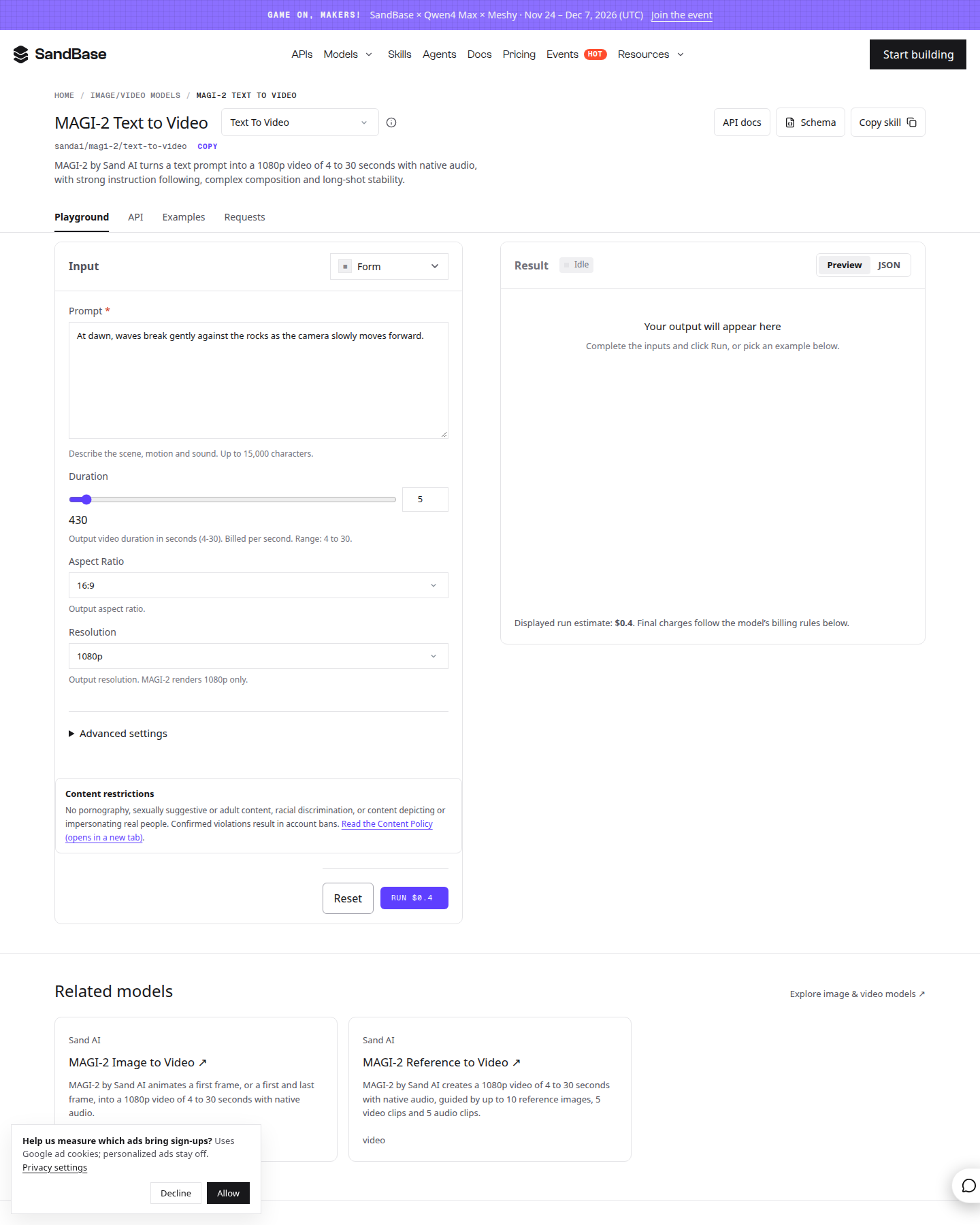
Live SandBase card for sandai/magi-2/text-to-video, captured 25 November 2026, Asia/Shanghai. Duration help says 4–30 seconds, billed per second. Resolution help says MAGI-2 renders 1080p only. The displayed estimate and the Run button are $0.4 at duration 5. The cookie prompt does not cover those figures.
Sand.ai’s API is a separate route
Sand.ai’s pricing page, fetched the same day, is a one-row table: model magi-2, resolution 1080p, pricing 0.08 USD/s. Above the table it says top-up is not supported for the time being. That sentence is about the Sand.ai console. The SandBase cards say pay per use from a SandBase balance, and their markdown FAQ says a separate Sand AI account is not required. This article did not create a key on either side, so a particular account’s balance, region, or enablement flag is unverified.
Sand.ai’s native reference uses POST https://api.sand.ai/v2/generations and "model": "magi-2". The body is a parts array: exactly one text item, up to 15,000 Unicode code points, plus up to 10 images, 5 videos, and 5 audio clips. resolution accepts only 1080p. duration on that native page is a positive whole number of seconds, and the page says the model must support the combination of ratio, resolution, duration, and input mode. The Ark-compatible page states the duration bound directly: 4–30 seconds, and it lists the six ratios 21:9, 16:9, 4:3, 1:1, 3:4, and 9:16. SandBase’s enum is those same six ratios, default 16:9. Sand.ai’s quickstart says to use a model enabled for the organization, and it gives magi-2 as the example. That enablement line is a Sand.ai organization setting.
A few fields exist on one side only. Sand.ai documents enhancePrompt, tells callers to omit watermark (including false), and accepts seed -1 as a random seed. The SandBase schemas checked here have no enhancePrompt and no watermark field. SandBase seed is an integer from 0 to 4294967295, and the help text says to omit it for a random seed. SandBase image-to-video marks prompt optional and requires image. Sand.ai’s native parts array requires the text item even when media is attached. The Ark page allows text to be optional once any media item is present. Copy the body from the card you are calling.
Preview weights and the hosted model
Sand.ai’s research post dated 24 November 2026 says MAGI-2 Preview shipped in August 2026 at about 114B total parameters and about 6B active, and that the flagship launched that day scales the base model to 480B total and about 28B active, with pre-training data expanded to about 4T tokens. The post says the hosted model generates up to 30 seconds of 1080p, 25 fps native audio-video, and that it supports reference across images, video, and audio, timeline control, and video editing. It also says an open-source release and a technical report will follow. The August preview post calls that release an intermediate research checkpoint, not the hosted API.
SandBase’s cards do not print parameter counts, frame rate, or an edit route. The vendor page lists three Sand AI video models, all under magi-2, and no video-edit id. The 25 fps figure, the timeline control, and the editing claim stay on the research post. They are not request fields on the three SandBase cards checked here. A leaderboard row labeled MAGI-2 Preview is a different name from these card titles. This article does not import arena scores.
Fields you can actually send
Text-to-video requires prompt, described as scene, motion, and sound, up to 15,000 characters. duration is an integer, default 5, minimum 4, maximum 30. resolution is the enum 1080p, default 1080p. aspect_ratio is 16:9, 9:16, 1:1, 4:3, 3:4, or 21:9, default 16:9. generate_audio defaults to true. seed is optional.
Image-to-video requires image, a public HTTPS URL. The schema description says JPEG, PNG, WebP, BMP, TIFF, GIF, or HEIC, under 30 MB. The playground widget beside First Frame and Last Frame also reads “PNG, JPEG, WebP, or GIF · 20 MiB maximum.” Both lines are on the live card. This check did not resolve which limit the API enforces. prompt is optional. end_image is an optional public HTTPS URL of the last frame. Duration, resolution, aspect ratio, audio, and seed match the text card. The short curl printed on the markdown card omits image. The schema marks image required, so that short sample is not a complete image-to-video body.
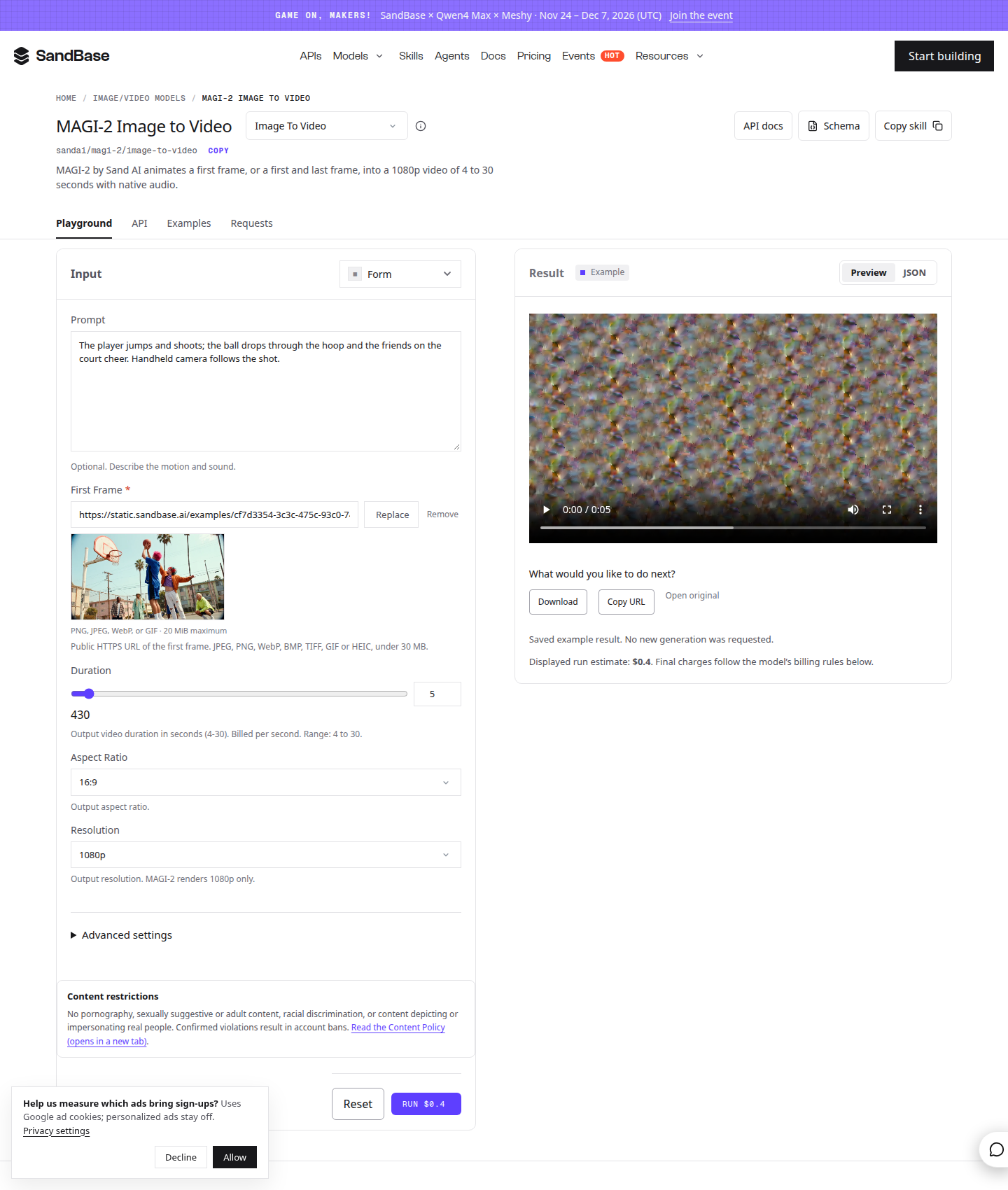
Live SandBase card for sandai/magi-2/image-to-video, captured 25 November 2026, Asia/Shanghai. First Frame is required. The widget says PNG, JPEG, WebP, or GIF, 20 MiB maximum, and the field help says a public HTTPS URL under 30 MB, including BMP, TIFF, and HEIC. The result panel is labeled “Saved example result. No new generation was requested.” The estimate is $0.4.
Reference-to-video requires prompt. images is up to 10 public HTTPS URLs, each under 30 MB. videos is up to 5 MP4 or MOV URLs, 2–30 seconds each, 30 seconds combined, up to 200 MB each. audios is up to 5 WAV or MP3 URLs, 2–30 seconds each, 30 seconds combined, up to 15 MB each. The card’s file note says to pass a publicly accessible URL, and that a video URL field does not imply video-upload support in the playground. Saved examples on the card show an images array and, separately, a videos array, each with duration 5 and aspect_ratio 16:9. Those examples are labeled as saved results. This article did not run them again.
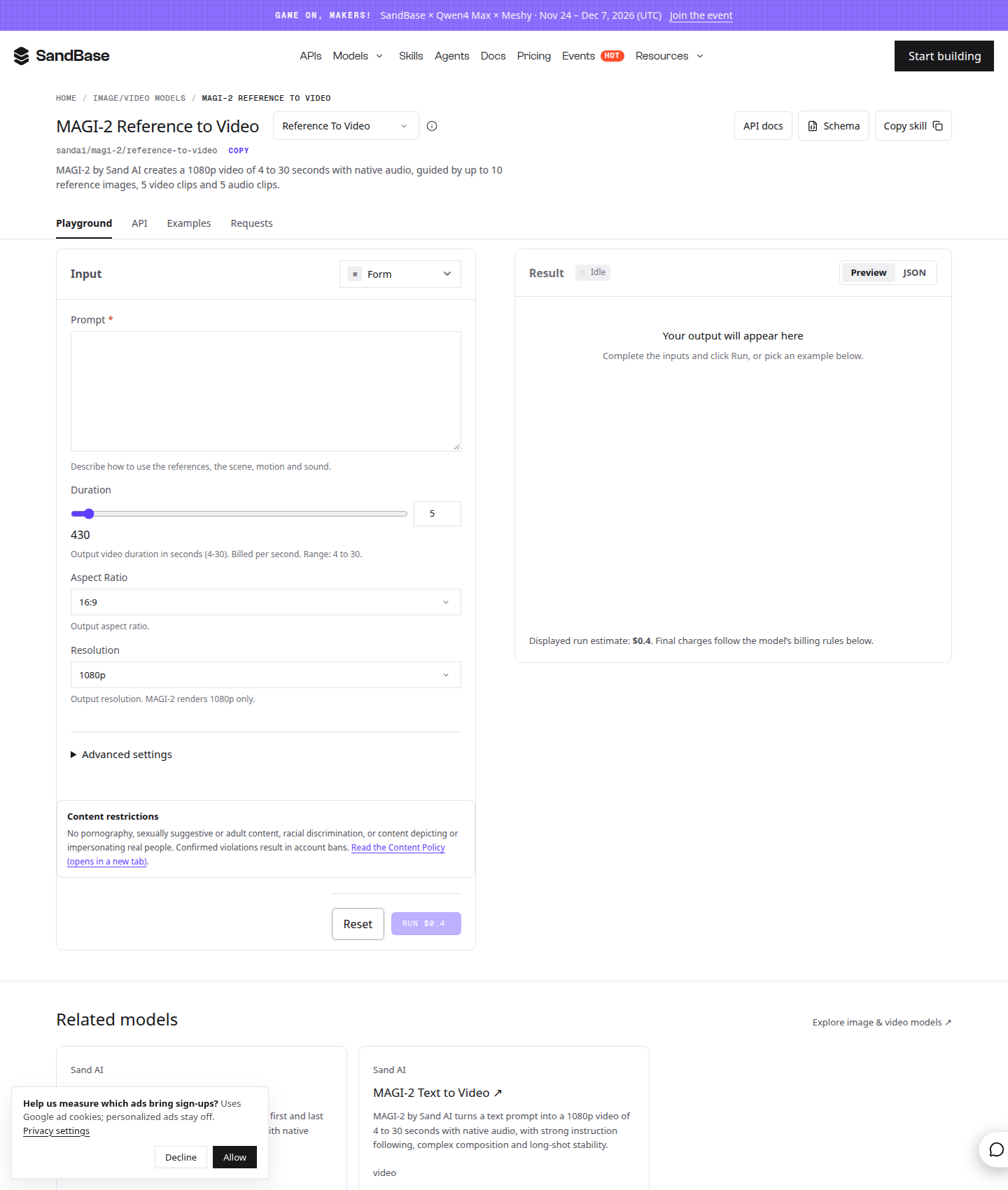
Live SandBase card for sandai/magi-2/reference-to-video, captured 25 November 2026, Asia/Shanghai. The lede says up to 10 reference images, 5 video clips, and 5 audio clips, at 1080p for 4–30 seconds. The visible estimate is $0.4 at duration 5. This crop ends before the reference URL fields. A cookie prompt covers part of the related-model row.
Every card’s playground states the same content rule: no pornography, sexually suggestive or adult content, racial discrimination, or content depicting or impersonating real people. It says confirmed violations result in account bans.
How to call it on SandBase
Open the MAGI-2 text-to-video card. Its API panel names the endpoint https://api.sandbase.ai/v1/run and the id sandai/magi-2/text-to-video. The panel says to poll with the returned run id until the status is completed, failed, or timeout, and to read output only after completed. The schema’s status enum is pending, running, completed, failed, and timeout. A completed example on the card is an outputs array of objects with a url. Create a SandBase API key on the login page (/signup redirects there). The first-call doc is a chat-completions walkthrough. MAGI-2 does not use that route.
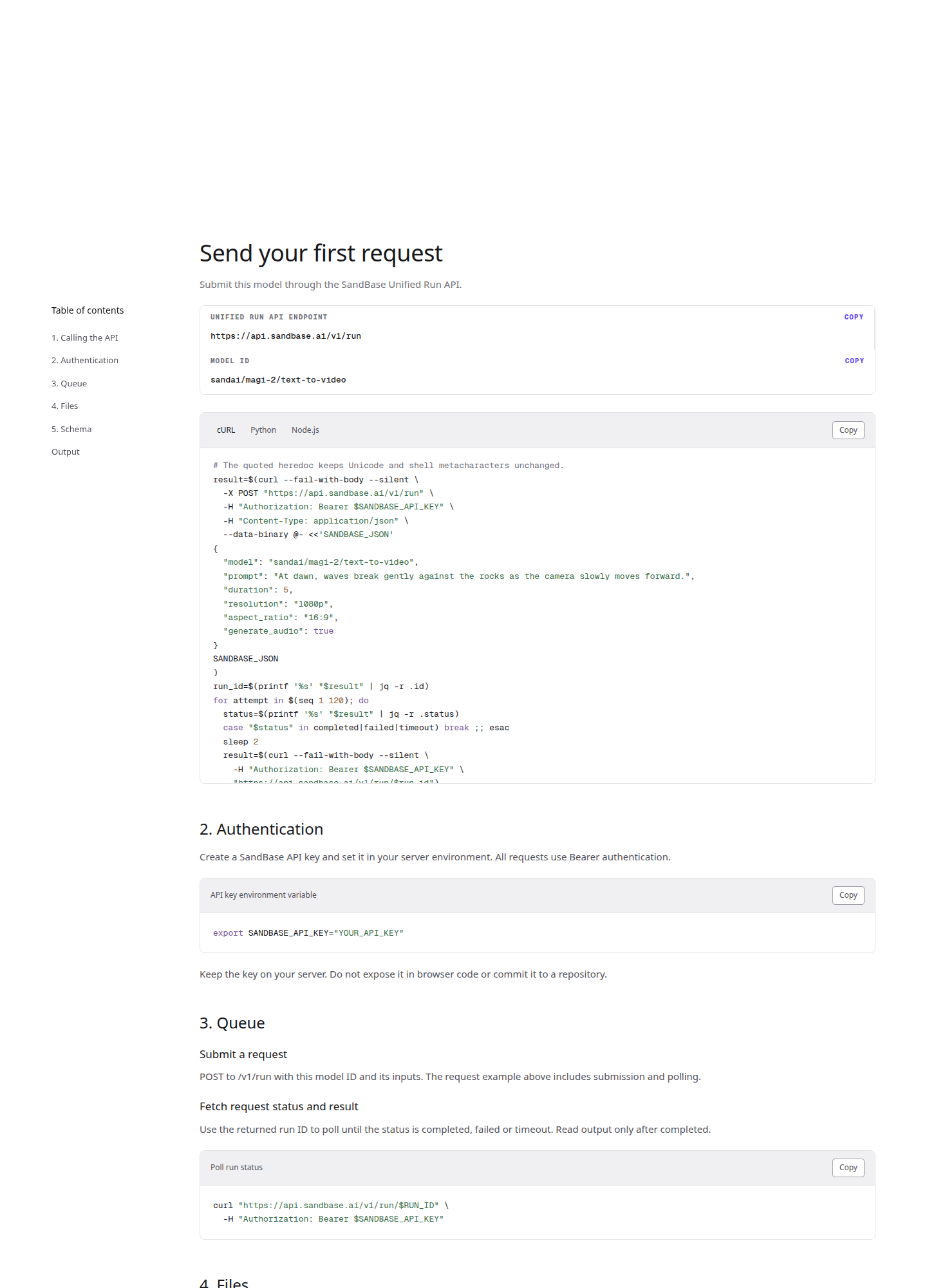
API panel on the same text-to-video card, captured 25 November 2026, Asia/Shanghai. It names POST https://api.sandbase.ai/v1/run and sandai/magi-2/text-to-video, and says to poll until the status is completed, failed, or timeout.
The text-to-video panel’s request, with the key kept in the environment, is:
curl -X POST https://api.sandbase.ai/v1/run \
  -H "Authorization: Bearer $SANDBASE_API_KEY" \
  -H "Content-Type: application/json" \
  -d '{
  "model": "sandai/magi-2/text-to-video",
  "prompt": "At dawn, waves break gently against the rocks as the camera slowly moves forward.",
  "duration": 5,
  "resolution": "1080p",
  "aspect_ratio": "16:9",
  "generate_audio": true
}'
That 5-second body is the $0.40 row. Change duration to 10 for the $0.80 row, or to 30 for the $2.40 row, using the card formula. For a start frame, change model to sandai/magi-2/image-to-video and send image. For references, change model to sandai/magi-2/reference-to-video and send the arrays that card documents. Do not send Sand.ai’s parts array, aspectRatio, or magi-2 to the SandBase route.
The card payload’s run_count was 0 at this fetch, and execution_mode is async. A zero counter is a catalog field at one moment. It is not a test of whether a call succeeds. No generation was submitted for this article, so latency, failure rate, and the final charge on a real account were not measured.
FAQ
Which id do I put in model?
On SandBase, one of the three ids above. sandai/magi-2/text-to-video is the prompt-only card. Image-to-video is the first-frame card, with an optional last frame. Reference-to-video is the card with image, video, and audio URL arrays. Sand.ai’s id magi-2 belongs on POST https://api.sand.ai/v2/generations.
Is 1080p a choice or the only output?
On the SandBase cards it is the only enum value, and the help text says MAGI-2 renders 1080p only. Sand.ai’s pricing row and API reference also list 1080p as the supported resolution. These pages do not document 720p or 4K for this model.
Why does the page say both $0.40 and $0.08?
From $0.40 is the public hero and the 5-second playground estimate. $0.08 is the per-second multiplier in price_formula. 5 × 0.08 = 0.40. 10 × 0.08 = 0.80. 30 × 0.08 = 2.40. 4 × 0.08 = 0.32. Sand.ai’s pricing page prints 0.08 USD/s on its own. The numbers match. The invoices, if you ever pull them, are still separate.
Does SandBase expose video editing or 25 fps?
The research post describes editing, timeline control, and 25 fps for the hosted model. The SandBase vendor page lists three video models and no edit id. None of the three schemas includes a frame-rate field or an edit input. Treat those research-post claims as vendor research until a SandBase card documents them.
Do I need a Sand.ai account, and can I top up there?
The SandBase markdown FAQ says one SandBase key is enough and a separate Sand AI account is not required. Sand.ai’s own quickstart says the model must be enabled for the Sand.ai organization, and the pricing page says top-up is not supported for the time being. This article did not verify either console for a specific account.
What to open
Call the text-to-video card for a prompt-only 1080p clip, and use the Sand AI catalog when you need the image or reference id beside it. Read the Run API for the async poll, then price the clip as output seconds times $0.08 from the card formula. A 5-second default is $0.40. A 10-second clip is $0.80.
SandBase cards and Sand.ai pricing, API, and research posts checked 25 November 2026, Asia/Shanghai. No generation was run, and this page has no benchmark.
Related reading
Found this useful? Share it