Magpie TTS: Open-Weight Deployment Checklist
Plan a Magpie TTS deployment with pinned model versions, voice and language checks, runtime selection, latency tests, and a clear boundary around voice cloning.
“Use Magpie for the voice agent” leaves an important deployment question unanswered: which Magpie model, delivered through which runtime? A downloadable multilingual checkpoint, an optimized runtime recipe, and a NIM service are related choices, but they do not have interchangeable interfaces or capability guarantees. Selecting the name alone is not enough to promise streaming, custom voices, or a particular response time.
This checklist focuses on NVIDIA’s nvidia/magpie_tts_multilingual_357m checkpoint and the surrounding deployment choices. Sources were checked on November 14, 2026. No audio synthesis, GPU capacity test, or latency benchmark was performed for this article; the evaluation steps below are a proposed plan for your own environment.
Key takeaway
- Pin the exact checkpoint and runtime before evaluating output quality.
- The current multilingual checkpoint offers fixed speaker voices; do not infer zero-shot cloning from the Magpie family name.
- NIM service capabilities need their own version and access checks.
- Measure queue time, first playable audio, and completed output separately.
Identify the artifact before choosing the server
The official NVIDIA model card identifies v2607 as the July 21, 2026 release. It lists 12 languages and five English speaker voices, under the NVIDIA Open Model License. The card states that this release removed zero-shot voice cloning. Those facts describe this checkpoint; they should not be silently extended to every service using the Magpie name.
The repository identifier contains 357m, while the current card describes a 364-million-parameter architecture. Keep the repository identifier intact when loading the model. Do not derive memory requirements or a performance ranking from the number embedded in its name.
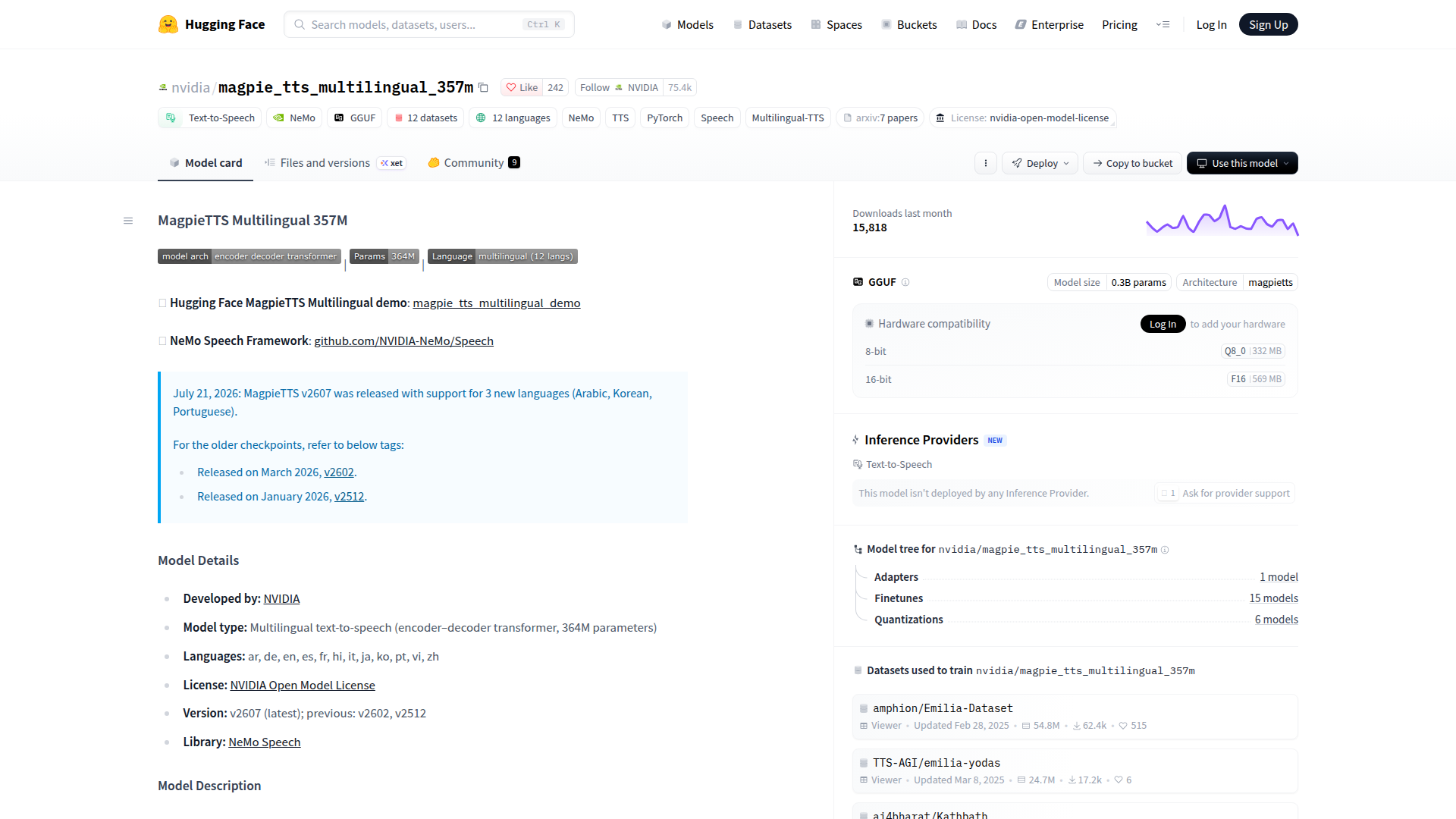 The NVIDIA model card captured November 14, 2026. It identifies the checkpoint, release notes, languages, and license; it is not evidence of a local inference run.
Create a deployment record with the repository, revision, downloaded artifact checksum, runtime revision, dependency lock, and device configuration. This record should travel with evaluation results. Otherwise, a quality report can become detached from the actual model after a routine rebuild fetches a newer revision.
The model card explains that its convenience loader follows the current main branch and describes downloading a versioned checkpoint for restoration. For production reproducibility, make that version choice explicit. A moving default is convenient for exploration but is a poor foundation for investigating why yesterday’s voice output differs from today’s.
Separate checkpoint, runtime, and service
The model is only one part of a deployment. Text preparation, tokenizer assets, audio decoding, scheduling, transport, and cancellation all affect what a caller experiences. Decide which layer owns each responsibility rather than attributing every behavior to the checkpoint.
| Deployment choice | What to verify | What it does not establish by itself |
|---|---|---|
| Downloaded checkpoint | Revision, license, supported inputs and outputs | Production throughput or a managed SLA |
| Local runtime | Compatible assets, build, device, and decoding path | Feature parity with a different server |
| Optimized recipe | Exact supported configuration and its tests | Your application’s latency under load |
| NIM service | Container/profile, model, API, and access | Identical behavior to a raw checkpoint loader |
The NVIDIA TensorRT-Model-Connect recipe provides a concrete reference for supported Magpie recipe configurations. Use it to identify an implementation path, then inspect the matching build and manifest. A documented recipe is not a measured result for your GPU, driver, text lengths, or concurrency.
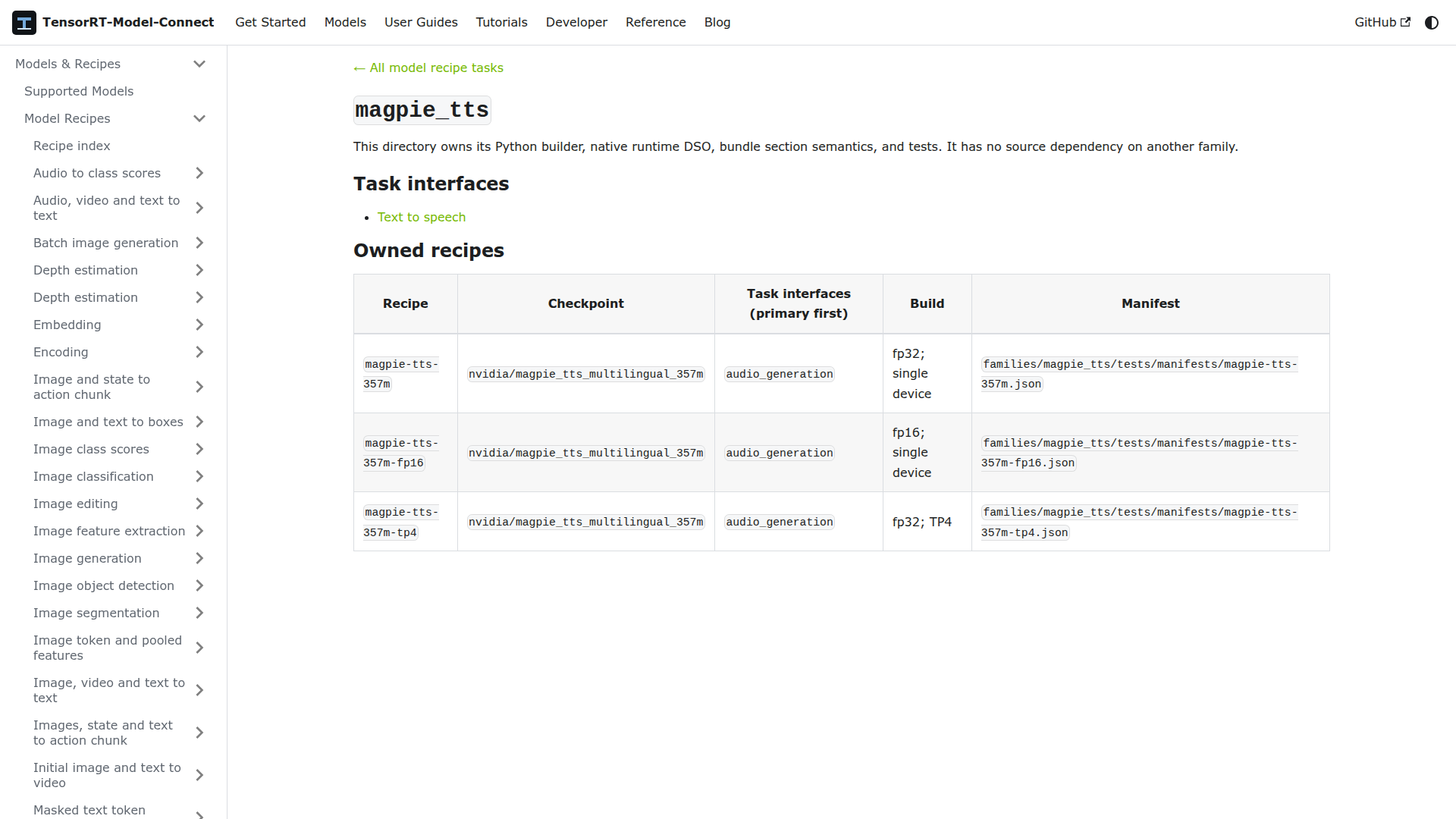 The official recipe page captured November 14, 2026. Its checkpoint and build entries identify configurations to examine; they do not provide a benchmark from this article.
For a first evaluation, choose one path and keep it stable. Switching between a Python loader, a native runtime, and a service while also changing test text makes failures difficult to attribute. Establish a baseline artifact and fixture set, then vary one component when investigating a difference.
Voice cloning is a separate decision
NVIDIA’s TTS NIM documentation lists Magpie Multilingual and Magpie Zeroshot separately. It describes reference-audio cloning for Zeroshot and notes an access-approval requirement. The multilingual checkpoint’s fixed-voice limitation therefore cannot be resolved merely by copying a parameter from a Zeroshot example.
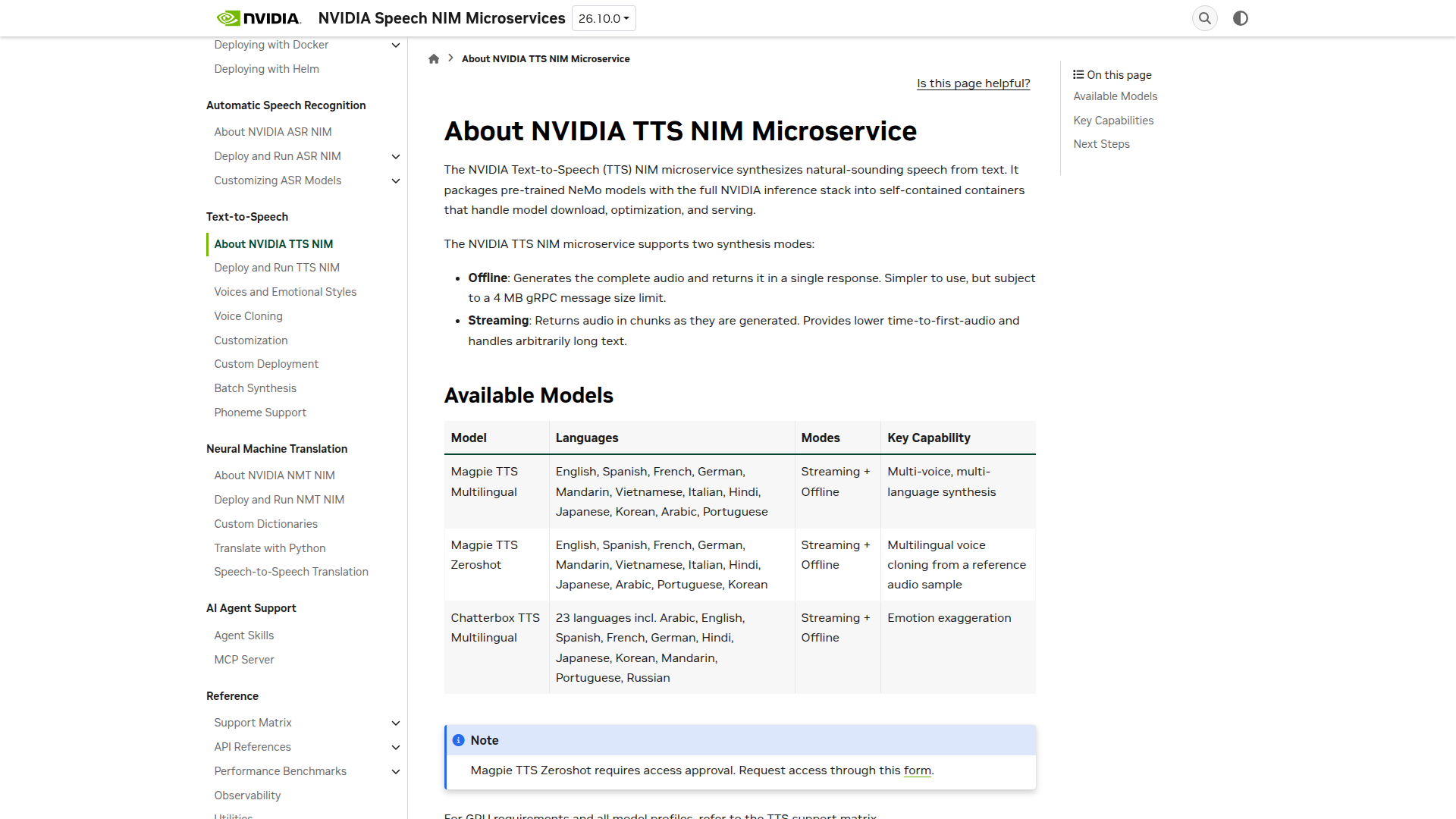 The NVIDIA TTS NIM overview captured November 14, 2026. Its model table separates Multilingual and Zeroshot; the distinction matters before promising a custom voice.
If the product requires a particular person’s voice, first settle the model and service selection, access, and permission to use the reference material. Keep that decision separate from the ordinary multilingual synthesis test. Passing a fixed-speaker test does not validate a cloning workflow, and successfully loading a checkpoint does not resolve rights to a voice recording.
For many applications, a consistent stock voice is sufficient. That choice reduces the amount of reference audio the product must collect and manage. It also changes the acceptance question: the team can evaluate intelligibility, style consistency, and pronunciation without trying to prove identity similarity. Make the requirement explicit before spending time optimizing the wrong path.
Build a fixture set around real text problems
Begin with the text that users will actually hear. A voice agent that reads appointment times needs different fixtures from one reading product codes or long educational passages. Include short confirmations, numbers, dates, abbreviations, names, punctuation, and the language transitions your product expects. Use authorized or synthetic test material without personal data.
Keep the original text and the text submitted to synthesis separately. If normalization expands a number or changes an abbreviation, the distinction helps explain a pronunciation failure. Record the chosen speaker, language, normalization options, and runtime version with every generated file. A folder of anonymous WAV files is difficult to compare reliably.
Use native-language review for the languages that matter to the product. A model card’s language list establishes intended support, not that every domain-specific name will sound correct. Ask reviewers to identify omitted words, repeated phrases, incorrect numbers, unnatural pauses, and pronunciation that changes meaning. Keep general preference separate from errors that make the output unusable.
Agree on an acceptance rule before listening to a candidate release. For example, a critical fixture containing an amount or appointment date should not be approved if that value is spoken incorrectly. The acceptable rate and review process are product decisions; this article does not supply invented quality scores or a universal pass threshold.
Measure the waiting the user experiences
A single “inference latency” number can hide several different delays. For an interactive agent, record when the application accepts the text, when the job begins running, when the first playable audio reaches the client, and when the full utterance completes. Keep those timestamps in the same clock domain or document how they are correlated.
Distinguish cold startup from a warmed worker. Also distinguish one request from concurrent requests and short text from long passages. If the server queues work, a fast model step may still produce a slow user experience. Queue time belongs in the result, not in a footnote removed from a headline benchmark.
Choose a transport test that matches deployment. The NIM documentation describes streaming and offline modes, but that does not establish streaming support for every checkpoint runtime. Test the selected interface’s actual chunk behavior and how the client starts playback. Record gaps and underruns separately from total completion time.
For capacity planning, observe the point at which the queue grows faster than it drains under the expected workload. Set an admission limit and a clear response when the system is busy. Do not choose an arbitrary concurrency setting because a GPU still has free memory: memory availability alone says little about acceptable waiting time.
Cancellation must reach playback
Voice agents are interrupted. A user may correct a question while an earlier answer is still being synthesized or played. The application needs a way to distinguish an obsolete utterance from the current one even if the old worker produces more audio.
Use an application-owned utterance identifier and associate it with the response generation that produced the text. When the user interrupts, stop accepting playback chunks for that utterance and apply the cancellation behavior supported by the selected runtime. This is a proposed application design, not a claim that Magpie supplies a complete conversational interruption protocol.
Test cancellation before synthesis, while queued, after the first chunk, and near completion. Inspect both the user’s experience and the resource behavior. Audio that no longer plays can still consume worker time if cancellation never reaches the server; conversely, cancelling a task without clearing the playback queue can leave the user hearing stale speech.
Keep the operational contract small and explicit
Define maximum text length, request timeout, supported languages, accepted voice choices, and the behavior for invalid input. Return a clear error for an unsupported option rather than silently selecting a different voice. If you split long text into chunks, preserve their order and define what happens when a later chunk fails.
Choose audio format and delivery behavior according to the actual client. Inspect the generated file or stream metadata, then test it with the player that will ship. A successful synthesis call is not enough if the browser, telephony adapter, or downstream processor cannot consume the result correctly.
Review the NVIDIA Open Model License linked by the model card before distribution or commercial deployment. Open weights describe access to artifacts; they do not eliminate license terms, service conditions, or responsibilities around the text and voices used by your application. Record the relevant version rather than paraphrasing it as “anything is allowed.”
A release packet another engineer can reproduce
A useful handoff contains the pinned deployment record, a small fixture corpus, generated outputs, review notes, timing measurements, and the rollback procedure. Include known failures with the same detail as passing examples. That makes the packet useful for deciding whether a change improves the actual workload.
The SandBase text-to-speech directory is a separate place to compare hosted speech options when operating a runtime is not the right fit. This link does not claim that the checkpoint described here is deployed on SandBase. Check the exact catalog entry and supported parameters before substituting a hosted route.
For cost accounting across the surrounding agent workflow, see API cost per call and agent pricing. Include speech generation, retries, idle capacity, and other services according to the costs your deployment actually incurs; the checkpoint name alone does not determine the cost of a completed conversation.
When should the deployment move forward? When the pinned artifact can be reproduced, important text is spoken correctly, waiting and cancellation meet the product’s requirements, and the team knows how to recover from a failed job. Until those checks are observed, model availability is a starting point, not a production readiness result.
Found this useful? Share it