Exa Search on SandBase.ai: From Search API to Agent Service
Exa Search is available through the SandBase ecosystem, helping agents connect AI-native semantic web search to research, monitoring, and FDE workflows.
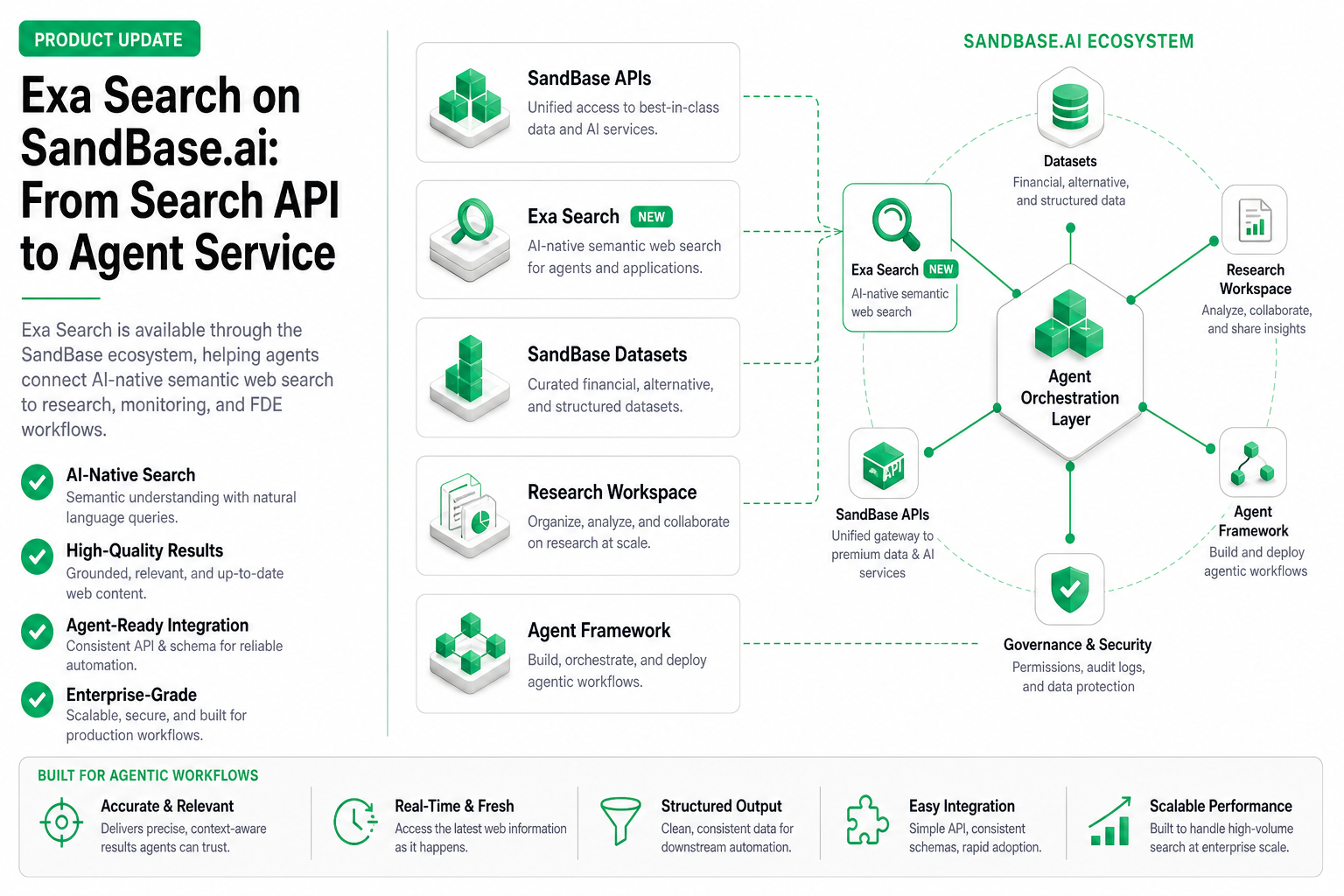
TL;DR — Exa Search is available through the SandBase ecosystem. Exa provides AI-native semantic web search and content extraction. SandBase helps agents connect and reuse that capability for company research, competitor monitoring, lead research, market mapping, and FDE delivery.
Search is one of the first capabilities every useful agent needs.
Not because search is flashy. Because almost every real task starts with the outside world.
Before an agent writes a report, qualifies a lead, maps a market, or prepares an FDE engagement, it needs to answer a few boring but essential questions: what is this company, what does it sell, who uses it, what changed recently, what sources can be trusted, and what should be passed to the next step?
That is why we are starting the SandBase Agent Service layer with Exa Search on SandBase.ai.
Why this matters
Raw search results are not enough for agents.
A human can scan ten links, open the promising ones, ignore the noisy ones, copy useful context, and keep mental notes about what matters. An agent needs that behavior turned into a workflow.
For production use, search needs to become more than a list of URLs. It needs source selection, extraction, highlights, summaries, citations, retries, state, and a structured output that another workflow can use.
That is the shift from API to Agent Service.
An API gives a program a function.
An Agent Service gives a task a reusable capability.
What Exa provides
Exa is an AI-native web search engine built around semantic search. Instead of only matching keywords, it is designed to find web content by meaning. It can return web results with optional content extraction, including full text, highlights, and summaries.
That makes Exa a strong provider layer for agent workflows.
When the task is “find relevant companies in this category” or “understand what changed in this product area,” semantic search is often closer to how the builder thinks. The intent matters more than the exact keywords.
What SandBase adds
SandBase is not trying to make Exa look like a different search API.
The SandBase layer is about making the capability easier for agents to discover, combine, and reuse:
- workflow shape
- reusable skill configuration
- session context
- structured artifacts
- follow-up steps
- run history
- integration with other agent capabilities
In practice, that means a builder should not have to wire search, extraction, summarization, and output formatting from scratch every time.
They should be able to run a repeatable workflow such as “research this company” or “monitor this competitor set” and get back a useful artifact, not just raw search responses.
First use cases
| Use case | What the agent does | Output |
|---|---|---|
| Company Research | Searches a company, website, product pages, customer signals, and recent updates | Company brief with sources |
| Competitor Monitor | Tracks websites, blogs, docs, GitHub, X, LinkedIn, and product launches | Change report |
| Lead Research | Researches accounts and people before outreach | Lead score and opener context |
| Market Map | Finds companies in a category and clusters them by segment | Market landscape artifact |
| FDE Prep | Builds context before a customer workflow discovery session | FDE research brief |
These are not exotic workflows. They are the daily work behind sales, investing, founder research, product strategy, and FDE delivery.
That is exactly why search is a good first Agent Service.
From API to Agent Service
The useful abstraction is not “call search.”
The useful abstraction is:
- research a company
- monitor a market
- prepare for a customer conversation
- collect signals for a lead
- build a source-backed brief
The provider supplies the raw capability. The runtime turns it into a repeatable path from task to artifact.
That is the product direction we care about at SandBase: connecting APIs, models, skills, tools, sessions, and artifacts into agent-native delivery workflows.
FAQ
Is Exa Search replacing normal web search?
No. Exa Search is useful when semantic matching and content extraction matter. For simple keyword lookup, traditional search can still be enough.
Why does SandBase call this an Agent Service?
Because the goal is not to expose one more API call. The goal is to package search, extraction, summarization, state, and artifact output into a reusable workflow that agents and builders can run repeatedly.
What can I build with Exa Search on SandBase.ai?
Start with company research, competitor monitoring, lead research, market maps, and FDE discovery prep. These are high-frequency workflows where better search directly improves the final output.
Does this work with other SandBase capabilities?
That is the direction. Search can become the first step in a larger workflow that later calls browser automation, SaaS connectors, model reasoning, sandbox execution, or report generation.
What comes next
Exa Search is a starting point.
The bigger goal is an Agent Service Store where builders can discover, inspect, run, and compose real-world capabilities. Search, browsing, extraction, SaaS actions, sandbox execution, reporting, and FDE playbooks should not live as disconnected glue code forever.
Agents need APIs.
But builders need reusable capabilities.
Exa Search on SandBase.ai is one small step in that direction.
Related Reading
- Exa Search vs Tavily vs Firecrawl vs SerpAPI: Search APIs for AI Agents in 2026
- Cloudsway vs Exa: Which Search API for Your Agent
- Top 6 AI Search APIs for Agent Workflows in 2026
- SandBase Product Update: Sharpening the Agent Infrastructure Layer
- Cloudsway Search: Ranked Results + Summaries
- AI Agent Infrastructure Stack 2026