Best AI Search APIs 2026: Agent Workflow Comparison
Best AI search APIs for agent workflows in 2026: compare Exa, Tavily, Firecrawl, SerpAPI, Google, and Brave on search quality, crawling, cost, and developer fit.
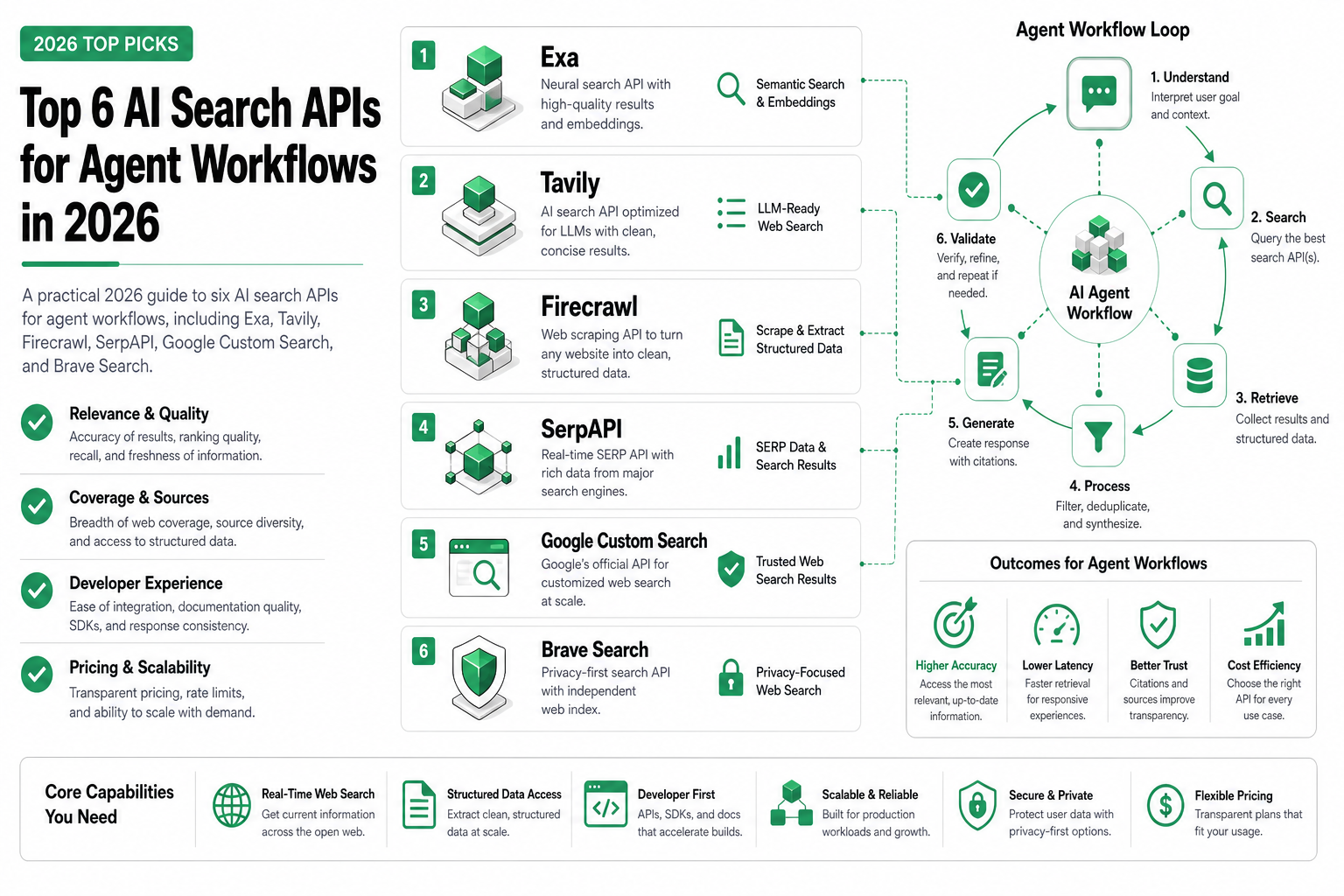
Top 6 AI Search APIs for Agent Workflows in 2026
TL;DR — The best search API for an agent depends on the job. Use Exa Search for semantic discovery and rich page context. Use Tavily for AI-oriented search and research workflows. Use Firecrawl for scraping and crawling known websites. Use SerpAPI or Google Custom Search when you need classic search engine result data. Use SandBase when you want to package these capabilities into reusable Agent Services with sessions, skills, and artifacts.
Every useful agent eventually needs to look outside the model.
It needs to research a company, monitor a competitor, find leads, check a market, read documentation, compare tools, or gather evidence before taking action.
That means search is no longer just a product feature. It is part of the agent runtime stack.
But not all search APIs solve the same problem. Some are built for semantic discovery. Some are built for AI research. Some are built for scraping and crawling. Some are built for classic search engine result pages. Some are better thought of as infrastructure components that need a workflow layer around them.
This guide compares the most useful options for AI agent workflows in 2026.
This is a shortlist, not a benchmark ranking
On July 31, 2026, we sampled Google US English results for AI search API for agents through DataForSEO’s Google Organic SERP Live API. The result set mixed Exa, Firecrawl, Parallel, OpenAI, Cloudflare, and community pages. That is a useful signal that this query covers several different jobs, not one winner-take-all product category.
So this article does not claim that tool number one is objectively better than tool number six. It is a practical shortlist organized by the first job an agent needs to complete. Search-result evidence informs the framing; it does not guarantee traffic, rankings, or demand.
How we evaluated these tools
We used five criteria:
- Agent fit: Does the output help an agent complete a task, or does it only return raw links?
- Content depth: Can the API return extracted text, summaries, highlights, or structured data?
- Workflow fit: Does it work well for research, monitoring, lead research, and FDE delivery?
- Developer experience: Is it easy to integrate and compose with other tools?
- Runtime needs: How much state, retry, observability, and artifact handling do you still need to build?
Quick selection table
| Tool | Choose it when | Strength | Trade-off |
|---|---|---|---|
| Exa Search | Your agent begins with an intent-led research question | Semantic discovery with extracted page context | Not a deep crawling or browser automation platform |
| Tavily | You want an AI-oriented web research toolkit | Search, extract, crawl, map, and research APIs for AI apps | Broader surface area than a focused search primitive |
| Firecrawl | You already know the websites to process | Converts sites into LLM-ready data | Discovery is not its only or central job |
| SerpAPI | Your workflow needs search-engine-shaped result data | Mature SERP and vertical-result extraction | Usually needs page extraction and reasoning after the SERP call |
| Google Custom Search JSON API | You need a configured Google-powered search surface | Official programmable search | Requires setup and is not an agent workflow layer |
| Brave Search API | You need an independent web search source | Useful for multi-provider search architectures | Still needs result selection and workflow logic |
1. Exa Search
The Exa API is a strong starting point for agent workflows because it is built around semantic discovery. Agents often start with intent, not exact keywords. That makes semantic search valuable for tasks like company research, competitor monitoring, lead research, market mapping, and FDE prep.
Exa can also return content context such as text, highlights, and summaries. That is important because agents usually need evidence, not just links.
When teams use Exa on SandBase, SandBase adds the workflow layer around the search call:
- define the task;
- call Exa Search;
- extract useful context;
- write a structured artifact;
- preserve session history;
- make the workflow reusable.
Best for:
- company research;
- competitor monitoring;
- lead research;
- market maps;
- AI research assistants;
- FDE preparation workflows.
Trade-off:
Exa Search is not a full browser automation or crawling platform. For deep crawling, pair it with a crawling/scraping capability.
2. Tavily
Tavily is designed for AI agents and LLM applications. Its developer docs describe search and adjacent web operations such as extraction, crawling, mapping, and research workflows.
This makes Tavily a good fit when you want a broad AI web research layer rather than a single search primitive.
Best for:
- research agents;
- web-aware assistants;
- quick search plus extraction workflows;
- agent prototypes that need an AI-native web toolkit.
Trade-off:
If your task is specifically semantic discovery plus rich page context, Exa may be a cleaner fit. If your task is full website ingestion, Firecrawl may be more direct.
3. Firecrawl
Firecrawl is more focused on website scraping and crawling. Its API documentation is useful when the agent already knows which site or documentation surface it needs to process.
For example:
- scrape a pricing page;
- crawl a docs site;
- convert pages to markdown;
- extract structured data from a website;
- monitor a known site for changes.
Firecrawl is a strong complement to search. Search finds candidate sources; Firecrawl processes selected sources deeply.
Best for:
- website ingestion;
- documentation crawling;
- structured extraction;
- LLM-ready page content.
Trade-off:
It is not only a search API. Use it when your workflow needs web data processing, not just discovery.
4. SerpAPI
SerpAPI is useful when you need structured search engine result page data. It can be a good choice when the workflow depends on familiar SERP outputs, search verticals, or search-engine-shaped results.
Best for:
- SERP monitoring;
- search result analysis;
- vertical search data;
- SEO and competitive intelligence workflows.
Trade-off:
For agents, SERP data often requires additional steps: page fetching, extraction, summarization, source scoring, and artifact generation.
5. Google Custom Search JSON API
Google Custom Search JSON API gives developers programmable access to Google-powered search over configured search experiences.
Best for:
- site-specific search;
- controlled search surfaces;
- applications that already use Google Programmable Search.
Trade-off:
It requires setup and configuration. It is not designed as a complete agent workflow layer.
6. Brave Search API
The Brave Search API is useful for teams that want an independent web search option. It can be part of a broader search stack when teams want multiple providers or want to avoid relying on one search source.
Best for:
- independent web search;
- multi-provider search workflows;
- search diversification.
Trade-off:
You still need to design the agent workflow around result selection, extraction, and artifact generation.
What most teams miss
The hard part is not making one search API call.
The hard part is making the result useful inside a production workflow.
An agent needs:
- state;
- retries;
- citations;
- source selection;
- structured artifacts;
- permission controls;
- observability;
- handoff to the next tool.
That is why SandBase treats search as an Agent Service, not just an API call.
FAQ
Which AI search API should I test first?
Test the one that matches the first workflow you will ship. For semantic company or market research, start with Exa. For a bundled agent web-research toolkit, test Tavily. For known websites and deep extraction, start with Firecrawl.
Do I need a browser automation tool as well?
Only when the task requires an interactive logged-in website, multi-step form actions, or behavior that ordinary search and crawling cannot perform. Search and browser automation solve different parts of an agent workflow.
Why not call the search API directly from the agent?
For a prototype, direct calls are often enough. Production workflows also need source handling, retry policy, permissions, output artifacts, session history, and observability. That is the layer SandBase is designed to provide.
Bottom line
If you are building an agent in 2026, start by separating the capability layer from the runtime layer.
Exa, Tavily, Firecrawl, SerpAPI, and Google Custom Search each provide useful raw capabilities. SandBase helps agents connect those capabilities into reusable workflows that builders and FDEs can actually deliver.
The future is not just “search API inside an agent.”
The future is search as a managed, reusable Agent Service.
Related Reading
- Exa Search vs Tavily vs Firecrawl vs SerpAPI: Search APIs for AI Agents in 2026
- Cloudsway vs Exa: Which Search API for Your Agent
- Cloudsway Search: Ranked Results + Summaries
- Exa Search on SandBase.ai: From Search API to Agent Service
- Best Embedding Models for RAG Agents (2026)
- AI Agent Infrastructure Stack 2026