DeepSeek Search and Fetch API: What It Is and What It Costs
DeepSeek opened its in-house Search and Fetch APIs on Oct 17, 2026 at $0.75 per 1,000 calls, free via server-side tools in Harness, Claude Code and Codex until Oct 31. What they do and when to use them.
For most of 2026, giving a DeepSeek agent access to the web meant bolting on someone else’s search API: pick a provider, manage a second key, pay a second bill, and hope its ranking matched what the model needed. On October 17, 2026, DeepSeek closed that gap by opening its own Search and Fetch APIs to everyone, powered by the same in-house engine behind its consumer app. The first number worth knowing is that, called the right way, they are free until the end of the month.
This explainer is based on DeepSeek’s documentation and open-source harness, without a live Search or Fetch API test. These endpoints use a DeepSeek API key, separate from SandBase model access. The sections below cover the documented tools, costs, framework behavior, and limits.
Key takeaway
- DeepSeek opened two web capabilities on Oct 17, 2026: Search (query the in-house engine) and Fetch (retrieve a public page’s content). Each is priced at $0.75 per 1,000 calls.
- Called as server-side tools inside DeepSeek Harness, Claude Code, and Codex, both are free for DeepSeek API users until Oct 31, 2026 at 16:00 UTC, after which the per-call price applies.
- The engine is DeepSeek’s own, indexing hundreds of billions of pages with multilingual, real-time results, and filtering SEO spam, GEO manipulation, and low-quality AI content.
- In DeepSeek’s open-source harness the model-facing tools are
web_searchandweb_fetch; fetch returns a status code plus bounded, decoded content and refuses non-public addresses, binary data, and unsupported types.- This is a DeepSeek-platform API. For the model side, see DeepSeek V4.1 Flash on SandBase. That model entry does not establish access to DeepSeek’s Search or Fetch endpoints.
What actually launched
DeepSeek’s change log for October 17 leads with the headline: “Opening up the in-house search API.” The description is specific about what the engine is. It is an AI-native general-purpose search engine that indexes hundreds of billions of web pages, supports multilingual search, and returns results in real time. It also claims a quality filter — screening out SEO spam, GEO manipulation, and low-quality AI-generated content — which is the kind of thing that matters more for a model than for a human, because a model will faithfully summarize whatever junk it is handed.
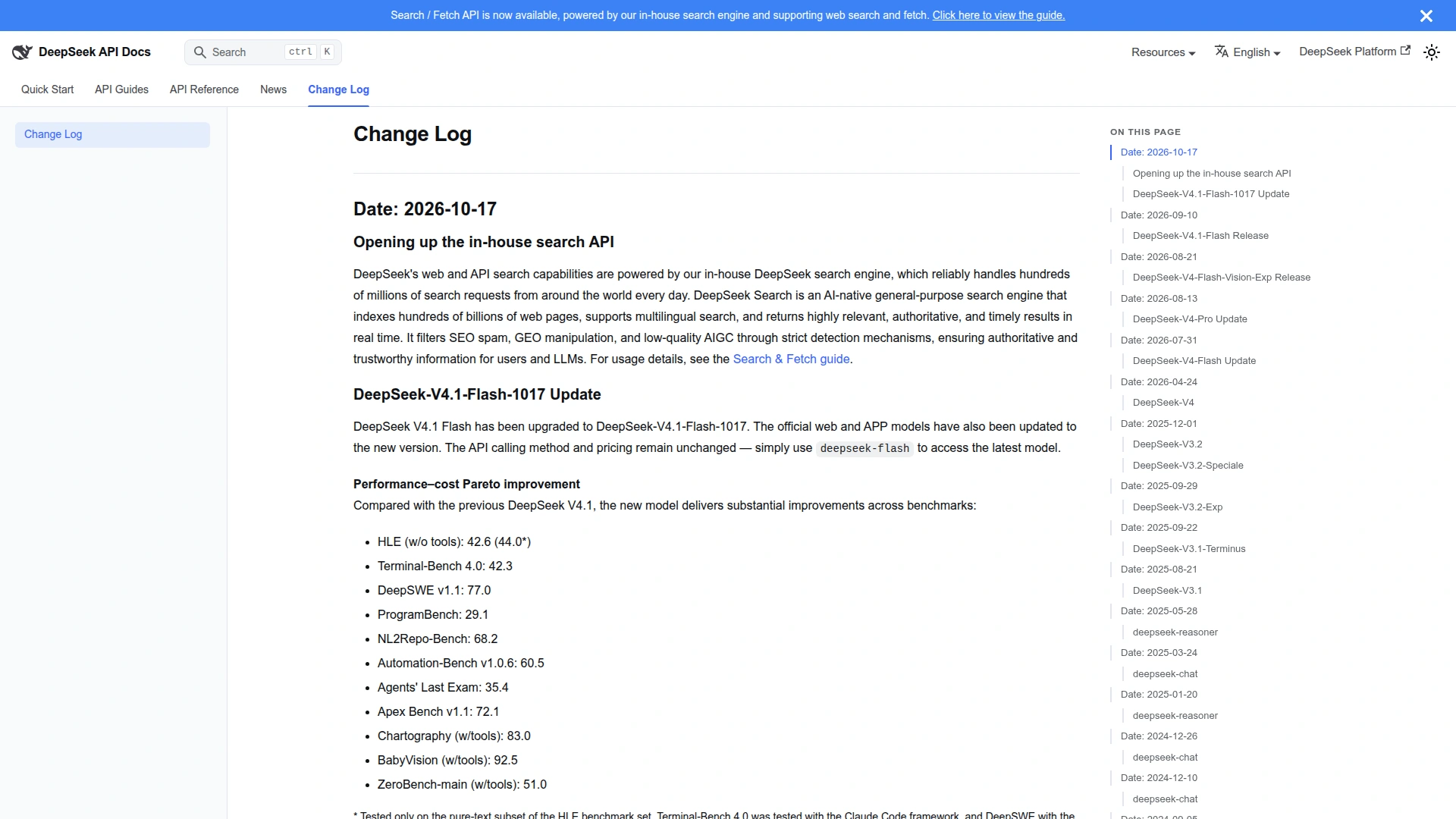 DeepSeek’s change log introduces the in-house Search API alongside the V4.1-Flash-1017 model update on the same day (captured 2026-10-17).
There are two capabilities, not one. Search takes a query and returns ranked web results. Fetch takes a URL and returns the page’s content. They are complementary: search finds candidate pages, fetch pulls the actual text so the model can read it rather than guess from a snippet. DeepSeek’s launch note frames them as a pair, and the pricing treats them as two separate meters.
The pricing, and the free window that actually matters
The launch announcement states the rate plainly: each endpoint costs $0.75 per 1,000 calls. For comparison, that is in the same range as mainstream third-party search APIs, with the difference that it comes from the same vendor as your model and needs no extra account.
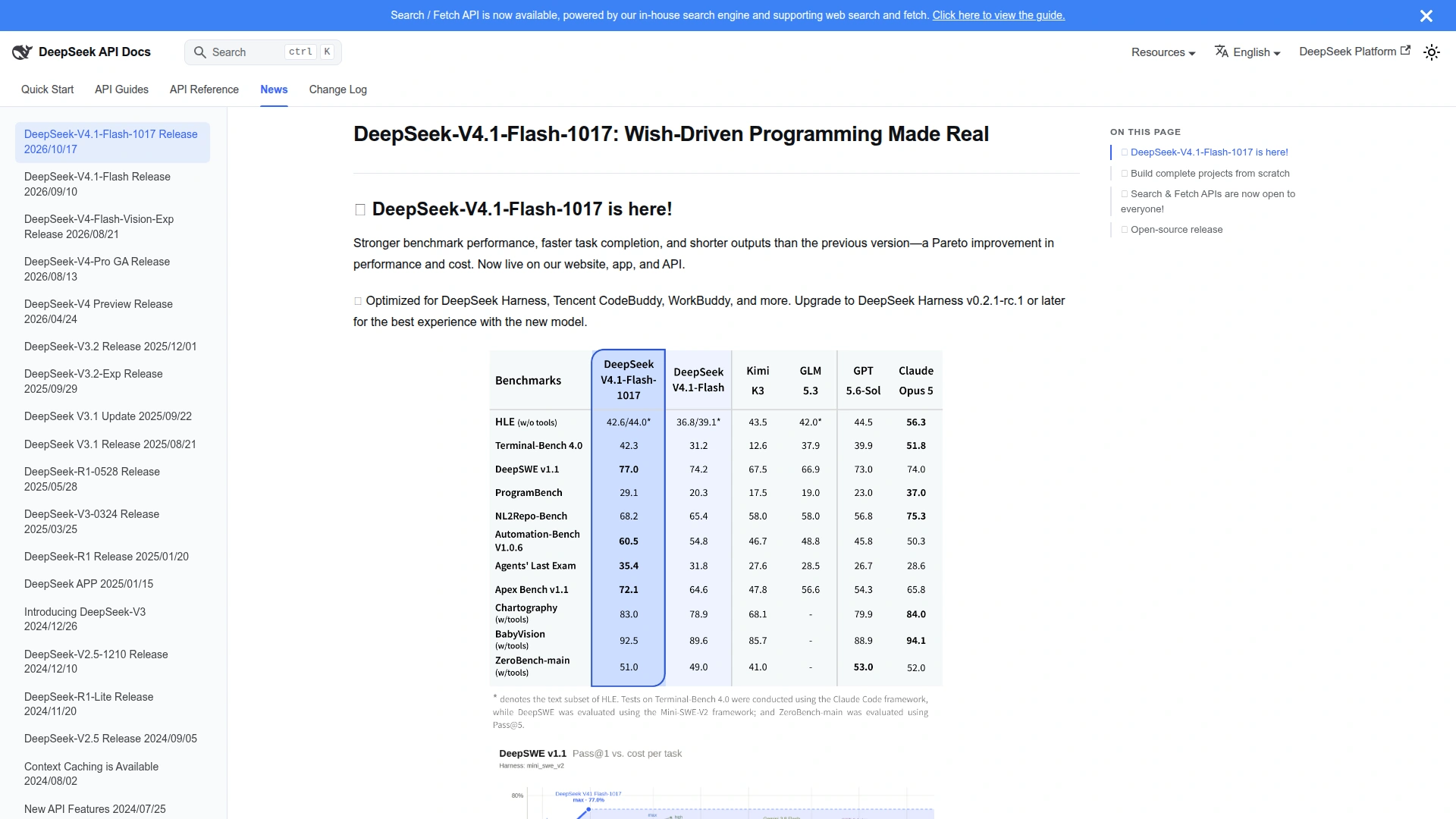 The launch announcement and its Search/Fetch navigation entry (captured 2026-10-17). The pricing and free-window terms are in the linked announcement, outside this screenshot.
The detail that changes the near-term math is the free window. DeepSeek says Search and Fetch calls made via server-side tools in DeepSeek Harness, Claude Code, and Codex are free for DeepSeek API users, with billing starting October 31, 2026 at 16:00 UTC. “Server-side tools” is the operative phrase: the model decides to search or fetch during generation, the platform runs the call, and the result is folded back into the response without a separate round trip from your code. If you wire the search through one of those harnesses now, you can evaluate it at no per-call cost for the rest of the month, then decide whether the quality justifies the $0.75 rate when billing begins.
That is a genuine evaluation window, not a permanent free tier. If you are costing a production system, model it at $0.75 per 1,000 Search calls and $0.75 per 1,000 Fetch calls, and treat October’s zero as a trial, not a baseline. A retrieval-augmented agent that searches once and fetches three pages per user turn makes four requests per turn after the window closes. The official billing guide counts only HTTP 200 responses with usable results: non-empty search results or fetched page content. Failed requests, empty searches, and timeouts are not billed.
How it shows up in an agent
The cleanest way to use these capabilities today is as model-facing tools inside a harness, rather than as raw REST you orchestrate yourself. DeepSeek’s open-source deepseek-harness repository documents the shape. The model-facing tools are named web_search and web_fetch, and they sit behind a single web middle layer so that one policy owns provider selection, errors, and configuration.
A few behaviors from that documentation are worth designing around. Each search request carries exactly one query; a consumer that accepts a list of queries fans them out into separate requests, so three queries produce three requests; each is billable only if it meets the successful-result condition above. The fetch tool retrieves public HTTP(S) pages and returns the status code plus bounded, decoded content without sending credentials. It returns non-2xx responses as results rather than throwing, and it rejects non-public addresses, binary data, and unsupported content types. That last set of rules is a safety boundary: it is designed to stop an agent from being steered into fetching an internal address or a binary blob.
I am describing the tool contract from DeepSeek’s documentation and repository, not from a run of my own. For the exact request and response fields, the authoritative source is DeepSeek’s Search and Fetch guide, linked from the change log; the launch note points to “API Guides - Search & Fetch” for usage details.
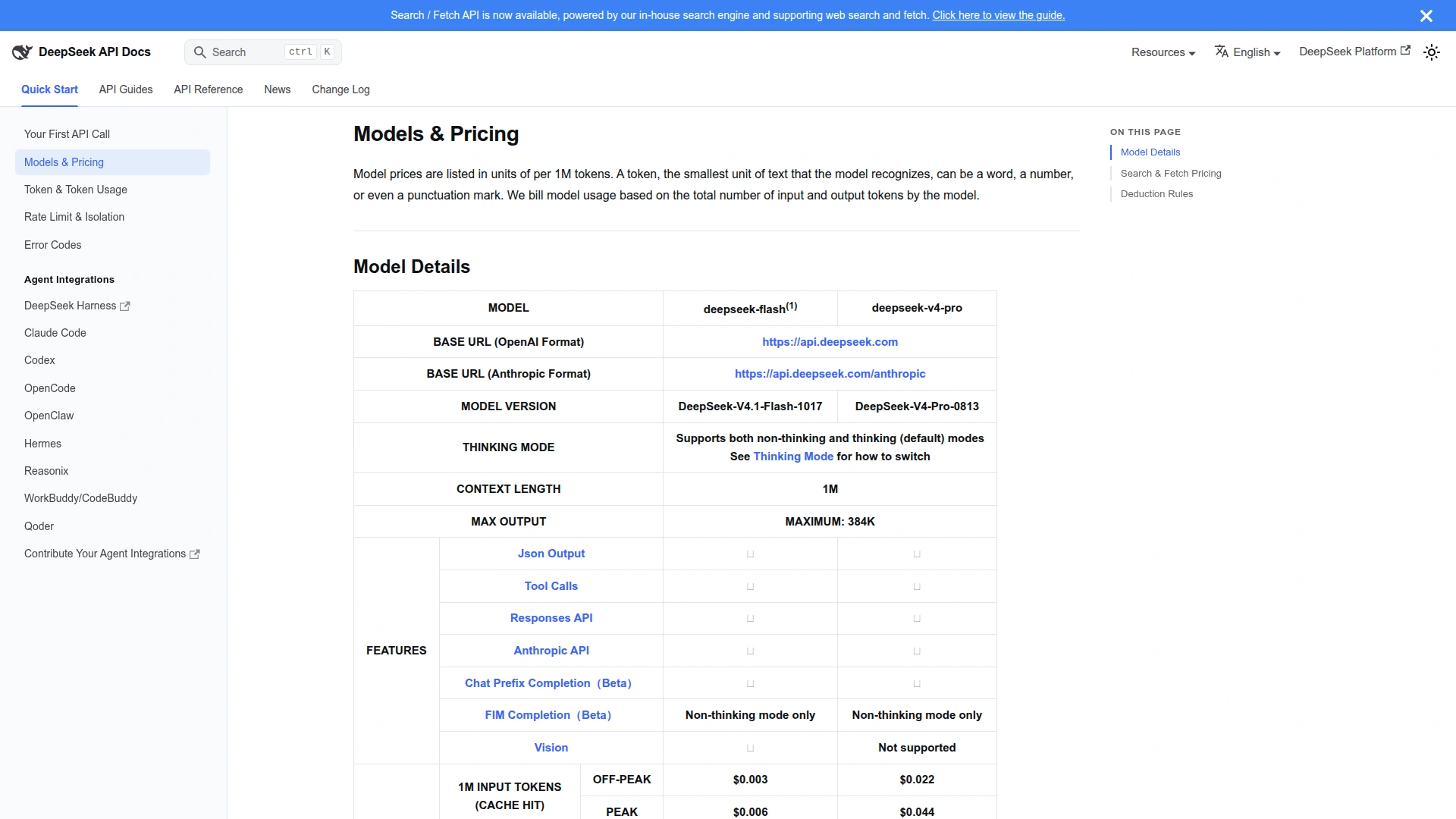 DeepSeek’s Models & Pricing page carries a dedicated “Search & Fetch Pricing” section and confirms
deepseek-flash is served by V4.1-Flash-1017 (captured 2026-10-17).
When to use it, and when not to
Reach for DeepSeek Search and Fetch when the agent you are building already runs on DeepSeek models through one of the supported harnesses and needs fresh, general web information. The appeal is operational simplicity: one vendor, one key, one bill, and a search layer tuned to feed a model rather than a human reading a results page. The spam and AI-content filtering is a real argument here, because retrieval quality caps answer quality.
Be more cautious in three situations. If you need a specialized index — academic papers, code, legal filings, a specific country’s local results — a general web engine may not be the right tool, and a domain API could rank better. If you are already standardized on a third-party search provider across several models, adding a DeepSeek-specific path fragments your stack for a marginal gain. And if your workload is high-volume retrieval, do the arithmetic at $0.75 per 1,000 after October 31 before you commit; a chatty agent can turn that into a meaningful line item.
There is also a plain limitation to state: because this runs best as a server-side tool inside specific harnesses (Harness, Claude Code, Codex), your framework choice and the free window are linked. If your stack is not one of those, confirm the standalone REST path and its pricing in DeepSeek’s guide before you assume the same free terms apply.
Where SandBase fits
Access note, October 24, 2026. DeepSeek Search and Fetch use DeepSeek credentials and terms. For a model request through SandBase, open the DeepSeek V4.1 Flash model page to check current pricing, the Playground, and request examples. The page lists deepseek/deepseek-v4.1-flash with /v1/chat/completions.
The public SandBase model page does not identify the served checkpoint as 1017. DeepSeek’s 1017 announcement describes its own service; it does not verify an upgrade on a third-party route. Confirm the served version before relying on checkpoint-specific behavior. The Python tutorial is related reading, not a current route-version check. This article does not verify DeepSeek Search/Fetch availability through SandBase or an end-to-end integration between the two services.
FAQ
How much does the DeepSeek Search API cost?
$0.75 per 1,000 calls, and the Fetch API is the same. Calls made as server-side tools inside DeepSeek Harness, Claude Code, and Codex are free for DeepSeek API users until October 31, 2026 at 16:00 UTC, after which the per-call rate applies.
What is the difference between Search and Fetch?
Search queries DeepSeek’s in-house engine and returns ranked web results for a query. Fetch retrieves the content of a specific public URL. A typical agent searches to find candidate pages, then fetches the ones it wants to read in full. They are billed as two separate meters.
Can I use DeepSeek Search without a harness?
Yes. The official guide documents standalone Search and Fetch JSON APIs using a DeepSeek API key. The temporary free offer described above applies to the named server-side tool integrations; do not assume it covers standalone requests.
Does the search engine filter low-quality content?
DeepSeek states that its engine filters SEO spam, GEO manipulation, and low-quality AI-generated content. That claim matters for agents specifically, because a model will summarize whatever sources it is given, so retrieval quality bounds answer quality. The claim is DeepSeek’s; this article does not independently verify filtering effectiveness.
Is this available through SandBase?
This article treats it as a DeepSeek-platform capability. SandBase’s relevant destination is the model, deepseek/deepseek-v4.1-flash, for the agent’s reasoning. The search and fetch calls are made on DeepSeek’s platform with a DeepSeek key.
Bottom line
DeepSeek Search and Fetch remove a recurring piece of plumbing: the separate web-search vendor that a DeepSeek agent used to need. At $0.75 per 1,000 calls each, the pricing is ordinary; the free server-side window through October 31 is the reason to evaluate now rather than later. The sensible move this month is to wire web_search and web_fetch into a supported harness, measure retrieval quality on your real questions while the calls are free, and only then decide whether to keep them on when the meter starts. For the model that sits behind that agent, the 1017 update and the Python tutorial are the next two stops.
Found this useful? Share it