Weibo & Xiaohongshu Data APIs Now on SandBase
64 Weibo and 36 Xiaohongshu data operations are now available through SandBase, covering hot search, user posts, influencer analytics, and commerce data.
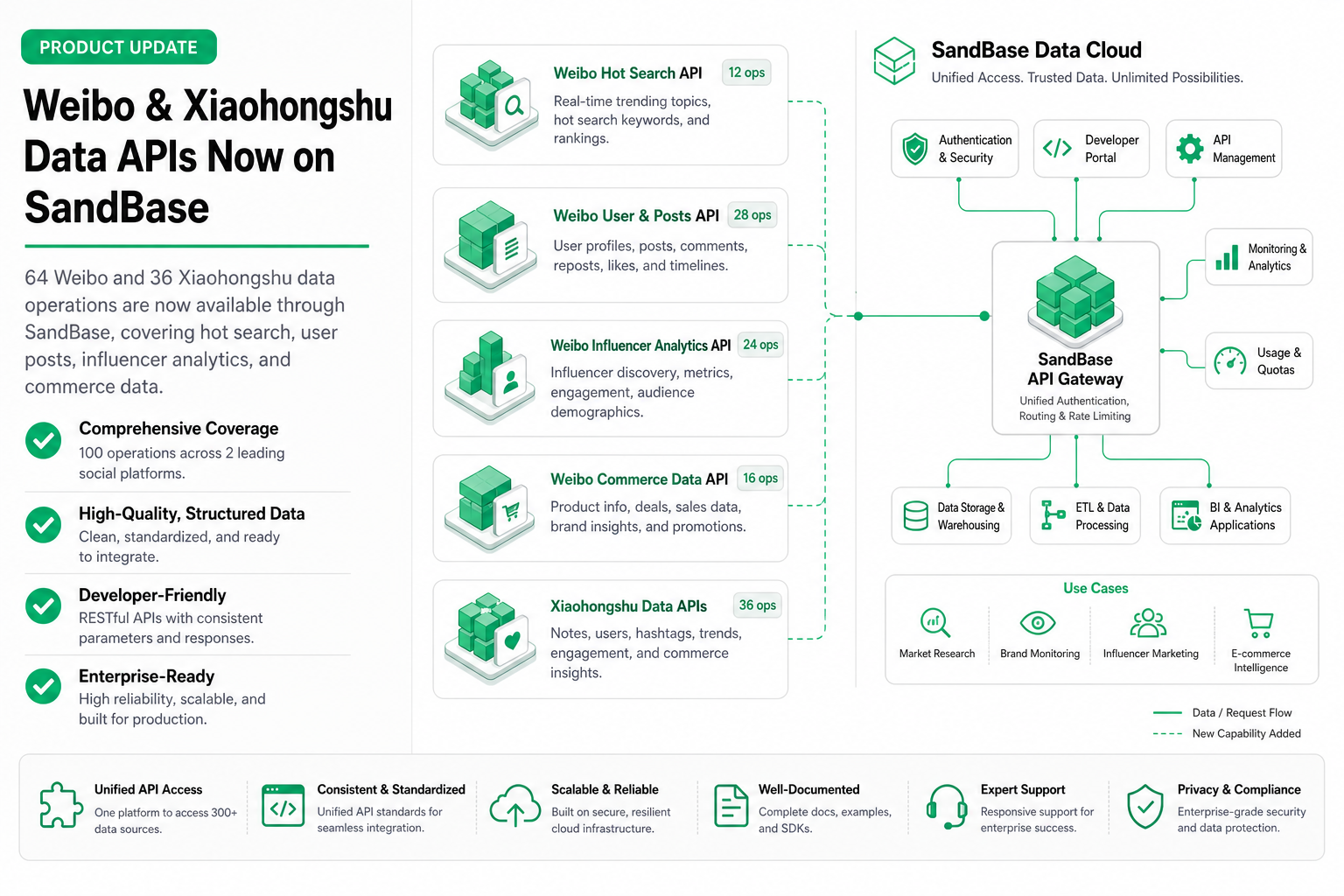
TL;DR — 100 new social media data operations: 64 for Weibo (hot search, public timelines, app-level user data — all at $0.001/call) and 36 for Xiaohongshu (blogger analytics via PGY, note details, product recommendations — $0.001-$0.02/call). Both platforms use the same
/v1/runcontract as every other SandBase capability.
Two platforms, two fundamentally different data profiles. Weibo is China’s real-time public square — breaking news, trending opinions, brand crises surface here first. Xiaohongshu is China’s consumption decision engine — product reviews, lifestyle content, and KOL recommendations drive purchase behavior.
An agent that monitors both captures the full spectrum: what people are talking about (Weibo) and what they are buying (Xiaohongshu).
Weibo: 64 operations, 3 channels
| Channel | Operations | What it covers | Price |
|---|---|---|---|
weibo/web-v2/* | 23 | Hot search, topic trends, public posts, user timelines | $0.001 |
weibo/app/* | 17 | App-level user data, relationship graphs, post details | $0.001 |
weibo/web/* | 10 | Legacy web endpoints, profile data, comment threads | $0.001 |
Every single Weibo operation costs $0.001. No tiers, no surprises.
What Weibo data enables for agents
Real-time trend detection: weibo/web-v2/hot-search returns the current hot search list with topic heat scores. An agent polling every 15 minutes catches brand mentions, industry trends, or crisis signals within one cycle.
Sentiment sampling: Combine hot search detection with weibo/web-v2/topic-posts to pull top posts for a flagged topic. Feed into an LLM for sentiment classification.
Competitive positioning: Track how competitors are discussed on Weibo. weibo/app/user-timeline gives you a competitor’s official Weibo post history; weibo/web-v2/post-comments gives you public reactions.
Example: brand crisis detection workflow
import requests
from openai import OpenAI

SANDBASE_API_KEY = "sk-..."
HEADERS = {
    "Authorization": f"Bearer {SANDBASE_API_KEY}",
    "Content-Type": "application/json",
}

# OpenAI client for LLM calls only
client = OpenAI(base_url="https://api.sandbase.ai/v1", api_key=SANDBASE_API_KEY)

# Step 1: Check hot search for brand mentions (direct HTTP)
hot_search = requests.post(
    "https://api.sandbase.ai/v1/run",
    headers=HEADERS,
    json={"model": "weibo/web-v2/hot-search"},
).json()

# Step 2: For each relevant topic, pull posts (direct HTTP)
topic_posts = requests.post(
    "https://api.sandbase.ai/v1/run",
    headers=HEADERS,
    json={"model": "weibo/web-v2/topic-posts", "topic_id": "flagged_topic_id", "count": 20},
).json()

# Step 3: LLM sentiment analysis (OpenAI SDK — correct for LLMs)
analysis = client.chat.completions.create(
    model="anthropic/claude-sonnet-4",
    messages=[{
        "role": "user",
        "content": f"Analyze sentiment of these Weibo posts about our brand:\n{topic_posts}"
    }]
)
Cost per cycle: 1 hot search + 3 topic fetches + 1 LLM call = ~$0.015/cycle. Running every 15 minutes: $1.44/day.
Xiaohongshu: 36 operations, 3 channels
| Channel | Operations | What it covers | Price |
|---|---|---|---|
xiaohongshu/app-v2/* | 20 | Note details, user profiles, search, product recommendations, faved notes | $0.001-$0.01 |
xiaohongshu/pgy/* | 10 | PGY (蒲公英) influencer platform: blogger lists, detail, fans history, campaign data | $0.02 |
xiaohongshu/web-v3/* | 6 | Homepage feed, hot lists, trending content | $0.001-$0.01 |
Xiaohongshu pricing has two tiers: basic content data at $0.001-$0.01, and PGY (蒲公英, Xiaohongshu’s official influencer marketplace) data at $0.02.
What Xiaohongshu data enables for agents
KOL screening: xiaohongshu/pgy/blogger-list returns influencers filtered by category, follower range, engagement metrics. xiaohongshu/pgy/blogger-detail gives deep analytics per creator. An agent can screen 200 KOLs for $4.
Content trend analysis: xiaohongshu/web-v3/hot-list shows what’s trending on Xiaohongshu right now. Combine with xiaohongshu/app-v2/search-images to find visual content patterns in your product category.
Product intelligence: xiaohongshu/app-v2/product-recommendations reveals what products are being recommended alongside yours. xiaohongshu/app-v2/user-faved-notes shows what content is being saved (high-intent signal).
Example: KOL evaluation per candidate
# Get blogger overview with engagement metrics
curl -X POST https://api.sandbase.ai/v1/run \
  -H "Authorization: Bearer $SANDBASE_API_KEY" \
  -H "Content-Type: application/json" \
  -d '{"model": "xiaohongshu/pgy/blogger-detail", "blogger_id": "5f3a..."}'

# Get their fans growth trend
curl -X POST https://api.sandbase.ai/v1/run \
  -H "Authorization: Bearer $SANDBASE_API_KEY" \
  -H "Content-Type: application/json" \
  -d '{"model": "xiaohongshu/pgy/blogger-fans-history", "blogger_id": "5f3a..."}'
Cost per KOL evaluation: 2 PGY calls × $0.02 + 2 content calls × $0.001 = $0.042/KOL. Screen 100 candidates: $4.20.
Cross-platform scenarios
Scenario: product launch monitoring
A consumer brand launches a new product. The agent monitors both platforms in parallel:
| Platform | What to monitor | Endpoints | Cost/day |
|---|---|---|---|
| Brand mentions in hot search, post sentiment | hot-search + topic-posts | $0.10 | |
| Xiaohongshu | Product-related notes, competitor recommendations | search + product-recommendations | $0.05 |
| Total | $0.15/day = $4.50/month |
Scenario: influencer campaign performance
After a KOL campaign launch, track real-time performance:
| Metric | Weibo endpoint | Xiaohongshu endpoint |
|---|---|---|
| Post engagement | weibo/web-v2/post-comments | xiaohongshu/app-v2/note-detail |
| Audience reaction | weibo/app/post-reposts | xiaohongshu/app-v2/note-comments |
| Creator growth | weibo/app/user-profile | xiaohongshu/pgy/blogger-fans-history |
What SandBase adds
Both platforms share the same runtime benefits as every other capability in the SandBase ecosystem:
- One contract: Weibo GET queries and Xiaohongshu POST bodies both normalize to
{"model": "...", ...params}through/v1/run - Cross-platform composition: A single workflow can call Weibo hot search → Xiaohongshu product search → LLM analysis without switching APIs or auth methods
- Cost tracking: See exactly how much each platform costs per agent session in your traces
- Skill reuse: Package “daily brand health check across Weibo + XHS” as one invocable skill
Limitations
- Weibo: All 64 operations are read-only. No posting, no direct messaging. Weibo’s official API with OAuth is needed for write operations.
- Xiaohongshu: 36 operations cover analytics and content discovery, not account management. PGY data ($0.02/call) reflects Xiaohongshu’s own influencer platform pricing.
- Both: Public data access through third-party infrastructure, not official platform authorization. Data freshness varies: hot search is near-real-time, historical analytics may lag.
FAQ
How does Weibo data pricing compare to Douyin?
Identical. All 64 Weibo operations cost $0.001/call — the same as 79% of Douyin operations. Weibo has no premium tier because its endpoints are simpler (mostly public timeline and search data vs Douyin’s creator analytics).
What can I learn from Xiaohongshu PGY data?
PGY (蒲公英) is Xiaohongshu’s official influencer marketplace. PGY data includes: blogger engagement scores, follower demographics, content category classification, campaign history, and fans growth curves. It’s the same data brands see when evaluating KOLs on Xiaohongshu’s own platform.
Can I track a specific Xiaohongshu note’s performance over time?
Yes. Call xiaohongshu/app-v2/note-detail periodically to track likes, comments, saves, and shares. At $0.001/call, tracking 50 notes daily costs $0.05/day.
Is there overlap between Weibo and Douyin coverage?
Minimal. They serve different platforms with different user behaviors. Weibo is text + opinion-first (trending topics, comments, reposts). Douyin is video-first (creators, engagement metrics, commerce). Most monitoring agents use both.
For the complete picture of social media data options, see our social media data API guide. For Douyin-specific coverage, see 310 Douyin APIs on SandBase.
Related Reading
- Xiaohongshu KOL Screening Agent (Tutorial)
- Build a Social Listening Agent: Weibo + Douyin
- Top 5 Social Media Data APIs for AI Agents (2026)
- 310 Douyin Data APIs Now Available on SandBase
- China Social Commerce Data: The Agent Opportunity
- SandBase Product Update: Sharpening the Agent Infrastructure Layer