Gemini 4 Carbon: Cybersecurity, Coding, Price, and Access
Updated 11 Nov 2026: Gemini 4 Carbon's public ID is gemini-4-carbon. Google intro is $2/$10 through 30 Nov, then $4/$20. SandBase lists it at $4/$20. Fairwind stays gated.
Google announced Gemini 4 Carbon on October 28, just two weeks after launching Argon. The surprising part, on that day, was the release order: Carbon went first to a small group of cyber defenders.
What changed on 11 Nov 2026, Asia/Shanghai. Google’s public paid launch is
datePublished2026-11-10T16:00:00+00:00, which is 11 November 2026 at 00:00 Asia/Shanghai. The public API ID isgemini-4-carbon. Google’s Developer API Standard intro is $2 per million input tokens and $10 per million output tokens through 30 November 2026, then $4 / $20. SandBase now lists the public model at Gemini 4 Carbon. The card shows $4 / $20 / $0.20 cache read per million, with no intro discount. The Fairwind cyber SKU,gemini-4-carbon-cyber-permissive, is still allowlisted and is not that card. Read what is confirmed, how to route it, and a call you can run on SandBase.
The rest of this page is still the 29 October reading of Google’s defensive benchmarks. Sentences that used to say the public ID, the context window, or the intro end date were unpublished now say what was true on 29 October and what is true on 11 November.
Key takeaway
- Gemini 4 Carbon is Google’s proprietary frontier model for long-horizon engineering and cybersecurity defense. The public model and the Fairwind cyber SKU are different IDs.
- Google reports 59 on Artificial Analysis Intelligence Index v5.0, 88.2% on SEC-bench Pro, 54.8% on ExploitGym, and 71.0% on CWE-bench. The model card ties the cybersecurity rows to Fairwind access.
- As of 11 November 2026 the public API ID is
gemini-4-carbon. On 29 October that ID had not been published, and access was Fairwind-only.- Google’s Standard intro is $2 / $10 per million through 30 November 2026, then $4 / $20. SandBase’s card shows $4 / $20, not the intro.
- Call the public model on SandBase when you want that ID. Keep Fairwind for the cyber SKU. Argon remains Google’s default for most other Gemini 4 work.

Google announced Gemini 4 Carbon on October 28, 2026. This official launch artwork establishes the named release; it is not evidence of model quality. Source: Google, retrieved October 29, 2026.
What is Gemini 4 Carbon?
Gemini 4 Carbon is a closed, multimodal frontier model from Google DeepMind. Google positions it as the stronger successor to Gemini 4 Argon, with the biggest gains in sustained agentic coding, vulnerability discovery, exploit validation, patch generation, long-context reasoning, and resistance to indirect prompt injection.
The word “successor” needs care. On 29 October, Google had announced Carbon, named a price, and begun a restricted rollout, without a public API identifier, context-window limit, maximum output, knowledge cutoff, model card, or generally available date. Those gaps closed on 11 November 2026 for the public model. The cyber SKU did not become a public default.
| Item | Status after the 11 Nov 2026 update |
|---|---|
| Provider | Google DeepMind |
| Public release | Paid public launch 11 Nov 2026, 00:00 Asia/Shanghai. On 29 Oct this row was Fairwind-only |
| Cyber SKU | gemini-4-carbon-cyber-permissive, still Fairwind / allowlist. Not the public ID |
| License / weights | Proprietary; no open weights announced |
| Modalities | Google docs: text, image, video, audio, PDF in, text out. SandBase hero chips: Text, image, audio |
| Context window | 1,048,576 unified tokens. Unpublished on 29 Oct |
| Maximum output | 65,536 default synchronous. SandBase hero: 65.5K. Google long decode up to 1M minus input is not the SandBase hero cap |
| Knowledge cutoff | March 2026. Unpublished on 29 Oct |
| Public API model ID | gemini-4-carbon. Unpublished on 29 Oct |
| SandBase availability | Listed. google/gemini-4-carbon at the card linked above. HTTP 404 on 29 Oct |
| Introductory price | Google Standard $2 / $10 per million through 30 Nov 2026; cached input $0.10 |
| Price after 30 Nov 2026, and the SandBase hero | $4 / $20 per million. SandBase also shows $0.20 cache read and no intro discount |
That list of unknowns is not a footnote. It is the practical difference between an impressive launch and a model you can safely put into a deployment plan.
What is actually new in Gemini 4 Carbon?
Long-horizon coding is the central bet
Google says internal teams have run Carbon for days on complex engineering tasks, including tracing and patching subtle bugs across large codebases and low-level systems. The public numbers support a narrower claim: Carbon improves over Argon on several agentic evaluations.
On Google’s Gemini comparison table, Carbon scores 65.2% on Terminal-Bench 4.0 versus Argon’s 57.1%. It reaches 61.2% on FrontierSWE 2 versus 55.0%, and 9.6% on SWE-sweep versus 4.3%. Carbon also gains 89 Elo points over Argon on WebDev Arena, landing at #4 with a score of 1768.
Those results do not mean Carbon will fix every repository. Harnesses, tool permissions, environment setup, retry policy, and verification still shape agent performance. On 29 October there was no public interface to reproduce the “runs for days” claim. On 11 November the public ID exists. A public ID is still not a reproduction of a multi-day internal run, and standard RPM remains unpublished.
Cybersecurity is a product boundary, not just a benchmark category
Carbon’s standout launch numbers cover three parts of a defensive workflow:
| Security task | Benchmark | Carbon | Argon | What it measures |
|---|---|---|---|---|
| Find vulnerabilities | SEC-bench Pro | 88.2% | 83.4% | Long-horizon bug hunting in real software targets |
| Validate exploitability | ExploitGym | 54.8% | 42.0% | Developing exploits for real-world vulnerabilities in a controlled benchmark |
| Patch root causes | CWE-bench | 71.0% | 68.0% | Producing working fixes for vulnerability classes |
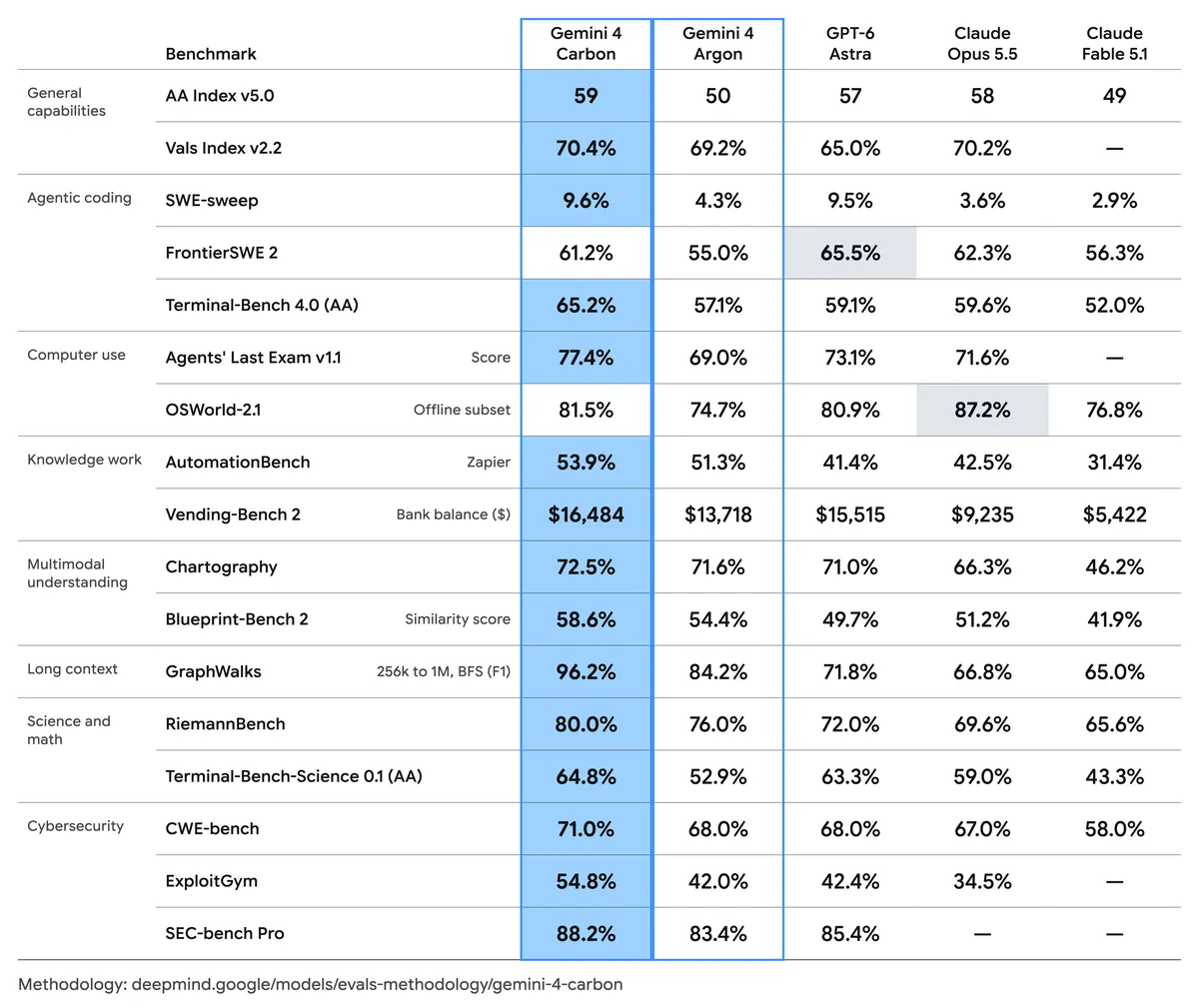
Google’s launch table reports Carbon’s largest practical gains in agentic coding, long context, and cybersecurity. These are provider-published results, not SandBase tests; several rows use Google-selected settings and harnesses. Source: Google DeepMind, October 28, 2026.
SEC-bench Pro itself describes a 344-instance suite spanning V8, Firefox, and Linux, with containerized targets, timeouts, generated artifacts, and checker-based evaluation. That is more informative than a toy security questionnaire. Still, Google’s 88.2% was evaluated without guardrails, according to the launch post. The DeepMind model card, published 10 November 2026, says cybersecurity benchmark results reflect performance when accessed through the Fairwind Program. Those rows are not a measurement of public gemini-4-carbon on SandBase. A production service with safety controls may behave differently. This page does not describe exploit steps.
This is where the rollout makes sense. A model that is better at finding and validating vulnerabilities is also more capable in dual-use work. Google’s Fairwind Program restricts access to vetted defenders and permits authorized threat simulation, reverse engineering, malware analysis, and defensive research—not malicious use or redistribution.
Long context: the benchmark, then the window Google later published
Carbon reaches 96.2% on Google’s GraphWalks evaluation over 256K-to-1M-token inputs, compared with Argon’s 84.2%. That suggests better retrieval and reasoning over very long inputs.
On 29 October the right reading was: the benchmark range is not an API specification. On 11 November, Google’s model docs do publish a unified 1,048,576-token window, and the SandBase hero shows 1M context with 65.5K max output. Size SandBase requests from the hero cap, not from GraphWalks and not from Google’s 1M long-decode figure, unless the card prints that figure.
Safety improvements aim at agent failure modes
Google reports that Carbon reduced successful cheating on Terminal-Bench 4.0 to 0.0%, cut unsupported claims by about 2× versus Argon in internal testing, and reduced high-severity misalignment alerts by almost 80% in its live coding environments. It also reports 26% less overreach and 29% less under-service.
These are useful targets because coding agents often fail by violating task boundaries rather than by writing syntactically invalid code. But most are internal measurements without enough public detail to reproduce. Treat them as Google’s launch claims, not independent guarantees.
Prompt-injection resistance is the most interesting safety number
On Gray Swan’s Indirect Prompt Injection benchmark, Google reports a 0.0% attack success rate for Carbon, down from 0.7% for Argon. GPT-6 Astra is shown at 8.5%, while Claude Opus 5.5 and Claude Fable 5.1 are shown at 1.0%.
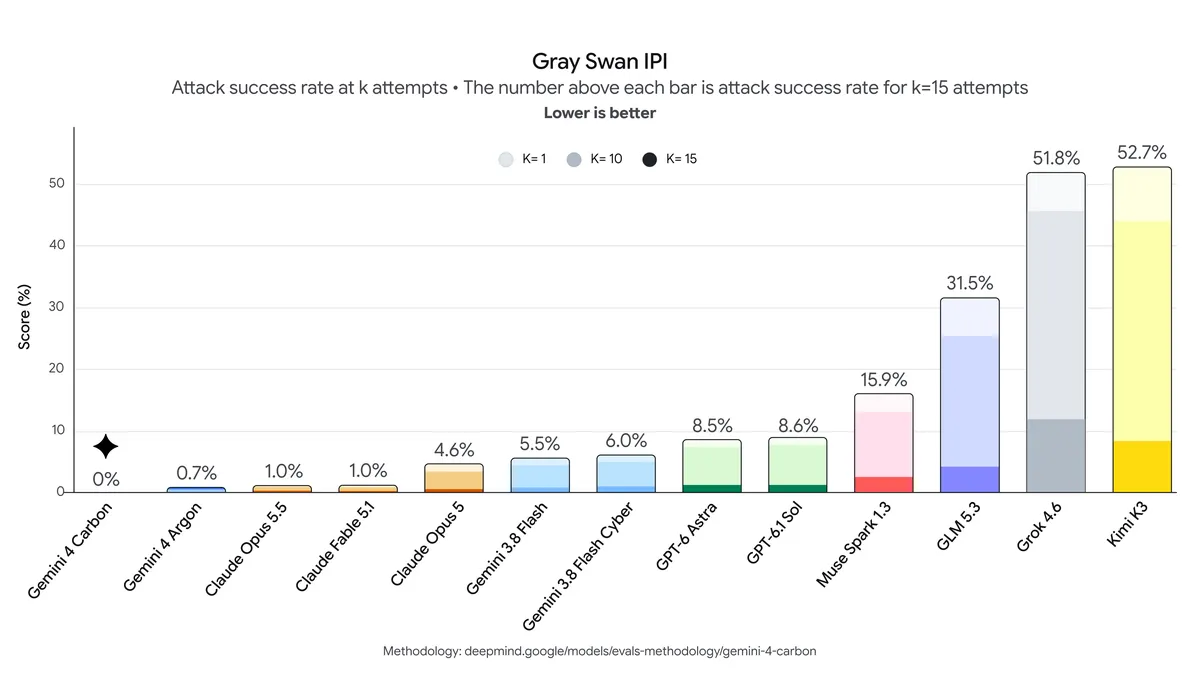
Google reports that Carbon resisted every attack in the evaluated Gray Swan IPI setup. “0.0%” means zero successes in that test configuration, not proof that prompt injection has been solved. Source: Google, October 28, 2026.
That last sentence is the important one. A zero observed failure rate is bounded by the prompts, tools, attempt counts, and agent design in the evaluation. New attacks and different integrations can reopen the problem. Teams should still isolate untrusted content, minimize tool privileges, require confirmation for consequential actions, and log tool calls.
Gemini 4 Carbon pricing
Google has two public Standard phases. The end date, unspecified on 29 October, is 30 November 2026. SandBase’s hero does not follow the intro.
| Phase | Input / 1M tokens | Cached input / 1M tokens | Output / 1M tokens | Dates |
|---|---|---|---|---|
| Google Standard intro | $2.00 | $0.10 | $10.00 | Through 30 Nov 2026 |
| Google Standard after, and the SandBase hero | $4.00 | $0.20 on the SandBase card | $20.00 | Google from 1 Dec 2026. SandBase hero already shows $4 / $20 / $0.20, no intro discount |
For a hypothetical task with 100,000 uncached input tokens and 10,000 output tokens, the announced introductory rate would cost $0.30: $0.20 input plus $0.10 output. At the standard rate, the same token counts would cost $0.60.
That is arithmetic, not a measured Carbon task. Google’s pricing page counts thinking tokens as output, so you do not add them a second time, and you also do not know yet how many thinking tokens a long coding job will emit. Price per million tokens is not the price of a completed patch. On SandBase, use $0.60 for this token mix, not $0.30.
Carbon vs Argon: should you wait?
| Choose | When it is the better decision | Main trade-off |
|---|---|---|
| Gemini 4 Carbon, public ID | The task is the limit case, and you can pay SandBase’s $4 / $20 hero rather than assuming Google’s intro | More tokens than Argon. Not the free tier. Not the cyber SKU |
| Fairwind cyber SKU | Authorized defensive work inside Google’s allowlist | Still gated. Benchmark rows from that access do not transfer automatically to gemini-4-carbon |
| Gemini 4 Argon | Most software engineering and knowledge work, including a production Gemini 4 API today | Lower results than Carbon on Google’s security and agentic tables |
| A cheaper fast model | Extraction, classification, chat, or short code completion with strong verification | Less persistence on complex multi-step work |
Do not pause an ordinary product integration for Carbon. Google still says Argon is the default for most of that work. Keep model IDs replaceable, and replay your own tests on google/gemini-4-carbon before you move traffic. The unit prices on the two SandBase heroes matched on 11 November 2026. The token volumes may not.
If your organization does authorized defensive security work, the Fairwind application is still the path for Carbon for cyber. Define false positives, patch correctness, scope compliance, tool-use logs, and time-to-verified-fix before access arrives. Do not treat a public chat completion as that program.
Can you call Gemini 4 Carbon through SandBase?
Yes, as of 11 November 2026. On 29 October the candidate path returned HTTP 404, and this article refused to invent an ID. The live card is Gemini 4 Carbon, model google/gemini-4-carbon, POST /v1/chat/completions, hero $4 / $20 / $0.20. The worked request is in the try-today note. Other Google models remain on the SandBase Google page. The Argon Python tutorial is still the longer client for the sibling ID.
The cyber SKU is not that card. Check the hero price again before you tell anyone the call is on the $2 / $10 intro. A name in a launch post was not an API contract in October. The contract now is the ID on the card, and it still does not include Fairwind.
Best use cases and limitations
Carbon is worth evaluating for authorized vulnerability discovery, patch generation with repository tests, long-running root-cause analysis, large-codebase migrations, and workflows that must inspect long mixed-format evidence before acting.
It is a poor reason to rewrite a normal chatbot, summarizer, classifier, or short code-completion pipeline. Those workloads usually benefit more from lower latency, predictable availability, and cost than from a frontier security score.
The largest limitation on the public model is no longer “there is no ID.” It is the gap between a paid API and the Fairwind numbers, plus unpublished standard RPM. Context and default output limits are now published. Latency, regional behavior on Agent Platform, and how many tokens a multi-day run actually burns are still things you measure yourself.
FAQ
Is Gemini 4 Carbon available now?
The public paid model, yes, as of 11 November 2026, 00:00 Asia/Shanghai. It is not on the free tier. Consumer surfaces that Google named require Google AI Ultra. Carbon for cyber remains Fairwind. On 29 October only the restricted track existed.
How much will Gemini 4 Carbon cost?
Google’s Standard intro is $2 / $10 per million through 30 November 2026, then $4 / $20. Cached input is $0.10 during the intro and $0.20 after, which is 95% off the matching input price. SandBase’s card shows $4 / $20 / $0.20 with no intro discount.
Is Carbon better than Gemini 4 Argon?
On Google’s published tables, Carbon leads Argon across the highlighted coding, long-context, security, and general-intelligence evaluations. The security rows are Fairwind-tagged. A public ID does not turn those cells into a SandBase measurement.
Does Gemini 4 Carbon have a 1M-token context window?
Yes, on the docs published by 11 November 2026: a unified 1,048,576-token window. On 29 October only the GraphWalks range was public, and that range was not an API limit. SandBase’s hero shows 1M context and 65.5K max output.
Is Gemini 4 Carbon open source?
No. Google has not announced open weights or an open-source license.
Conclusion
Gemini 4 Carbon is not “Argon, but a little higher on a leaderboard.” Google is defining it around sustained engineering and the full defensive-security loop: find a bug, validate the risk, patch the cause, and resist hostile instructions while doing it.
The restraint is the part that survived the public launch. Carbon is now a paid API, and it is listed on SandBase at $4 / $20, not at Google’s intro. The cyber SKU is still gated, and the defensive scores above are not a recipe. For most developers, keep shipping on Argon, then move a limit-case job to google/gemini-4-carbon after your own tests. Do not point that job at an imagined Fairwind endpoint.
Sources checked 29 October 2026, and access, price, ID, and context facts rechecked 11 November 2026: the October announcement, the November availability post, the DeepMind model card, Fairwind, SEC-bench Pro, and the live SandBase card. The reader-supplied WeChat article could not be retrieved, so it stayed an angle reference rather than evidence.
Found this useful? Share it