Claude Text Watermarking: API Builder Checklist
Understand Claude text watermarking, detector access, C2PA file credentials, and the evidence API teams need when reviewing AI transparency obligations.
A customer asks whether a paragraph came from Claude. Your application knows which request produced the draft, but the customer has only a pasted excerpt. Those are different evidence problems. An internal generation record can document a particular request; a statistical watermark can provide a signal about text after it leaves the application. Neither should be presented as a universal authorship certificate.
This article explains how to review that boundary using Anthropic and European Commission sources checked on November 14, 2026. It does not report access to Anthropic’s private detector, test watermark accuracy, or determine whether a particular product complies with the EU AI Act.
Key takeaway
- Claude’s text watermark is a statistical signal, not an invisible identifier added to each answer.
- Detector access is restricted; do not build against an invented public endpoint.
- Text watermarking and C2PA file credentials are different mechanisms.
- Keep provider evidence, application records, and publication disclosures separate.
What Anthropic actually announced
Anthropic’s watermark explanation, published August 14, describes a version of SynthID-Text. It changes token sampling rather than appending hidden characters or extra tokens. Detection concerns the likelihood that Claude was involved; it does not reveal an individual user, organization, or conversation.
The practical consequence is that searching the returned string for a secret marker is the wrong integration task. A team should instead identify what the provider claims for the exact model and route it uses, and preserve enough application evidence to describe its own processing. The announcement discusses a rollout, so this article does not assume identical coverage across all older Claude models.
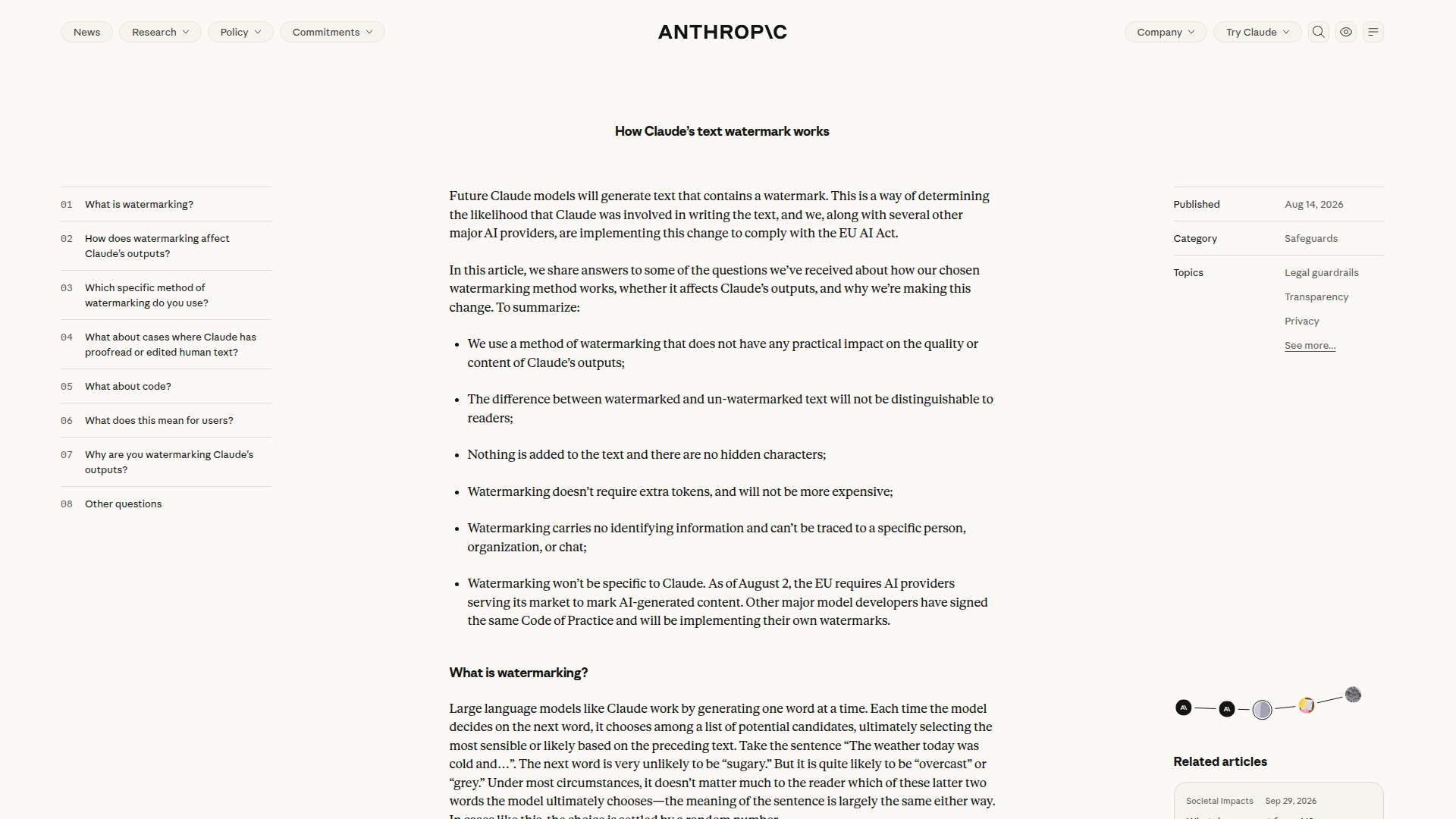 Anthropic’s public explanation captured November 14, 2026. This documents the provider’s stated mechanism and limitations; it is not a detector result for a sample of text.
There is also a useful product distinction: “generated with Claude” and “proved to be entirely authored by Claude” are not interchangeable statements. A draft may include human sentences, model edits, quotations, and later revisions. Your application can record the actions it performed without claiming to reconstruct the entire history of the final paragraph.
Do not turn detection uncertainty into a verdict
Anthropic describes limitations for tightly constrained text and code and notes that editing affects interpretation. A negative signal is not proof of human authorship. A positive signal does not identify a person. Those limitations matter most when the application proposes a consequential action based on the result.
A defensible review flow preserves uncertainty. Record which material was submitted, the detector version or service information actually returned, and the result as supplied. If your organization lacks detector access, say that the content was not checked with that detector. Avoid substituting an unrelated classifier and labeling its output “Claude verification.”
For an internal publishing tool, a useful state model might be not_checked, checked, and requires_review, with the actual evidence attached separately. These are proposed application states, not Anthropic response fields. They stop the interface from collapsing “not checked” and “no signal found” into the same reassuring green badge.
Do not invent numerical thresholds for approval. A threshold needs the detector’s documented meaning and an evaluation appropriate to the intended decision. If the only available material is a product announcement, it cannot support a claim that a chosen score reliably separates human and AI text in your workflow.
Detector access is part of the design constraint
Anthropic describes the detection API as a private preview for eligible organizations and selected enterprises. A public announcement about an API is not a public API contract. This guide therefore provides no speculative endpoint, authentication header, or sample detector response.
Before making detection a release dependency, obtain the actual access terms and documentation. Identify the allowed use, input handling, output semantics, and failure behavior. Keep the provider contact and approval record with the integration notes so a later engineer can distinguish an available capability from a planned one.
If access has not been granted, your product can still improve its own provenance records. Save the model identifier received or requested, request timestamp, route, template version, and the relationship between generated and published artifacts. Those records support statements about your application. They do not replace detection of arbitrary text copied from somewhere else.
There is a trade-off in how much output to retain. Keeping every draft helps reconstruct editing history but also creates a larger sensitive-data store. A content hash can help compare exact artifacts without retaining their full content, yet it cannot explain a changed paragraph or prove who edited it. Choose the evidence according to the question you need to answer.
Machine-readable marking and user-facing disclosure are separate work
The European Commission’s Article 50 FAQ discusses transparency obligations for different roles and uses. Do not compress that discussion into “the model has a watermark, therefore our application is compliant.” The relevant role, output, context, and conditions need their own review.
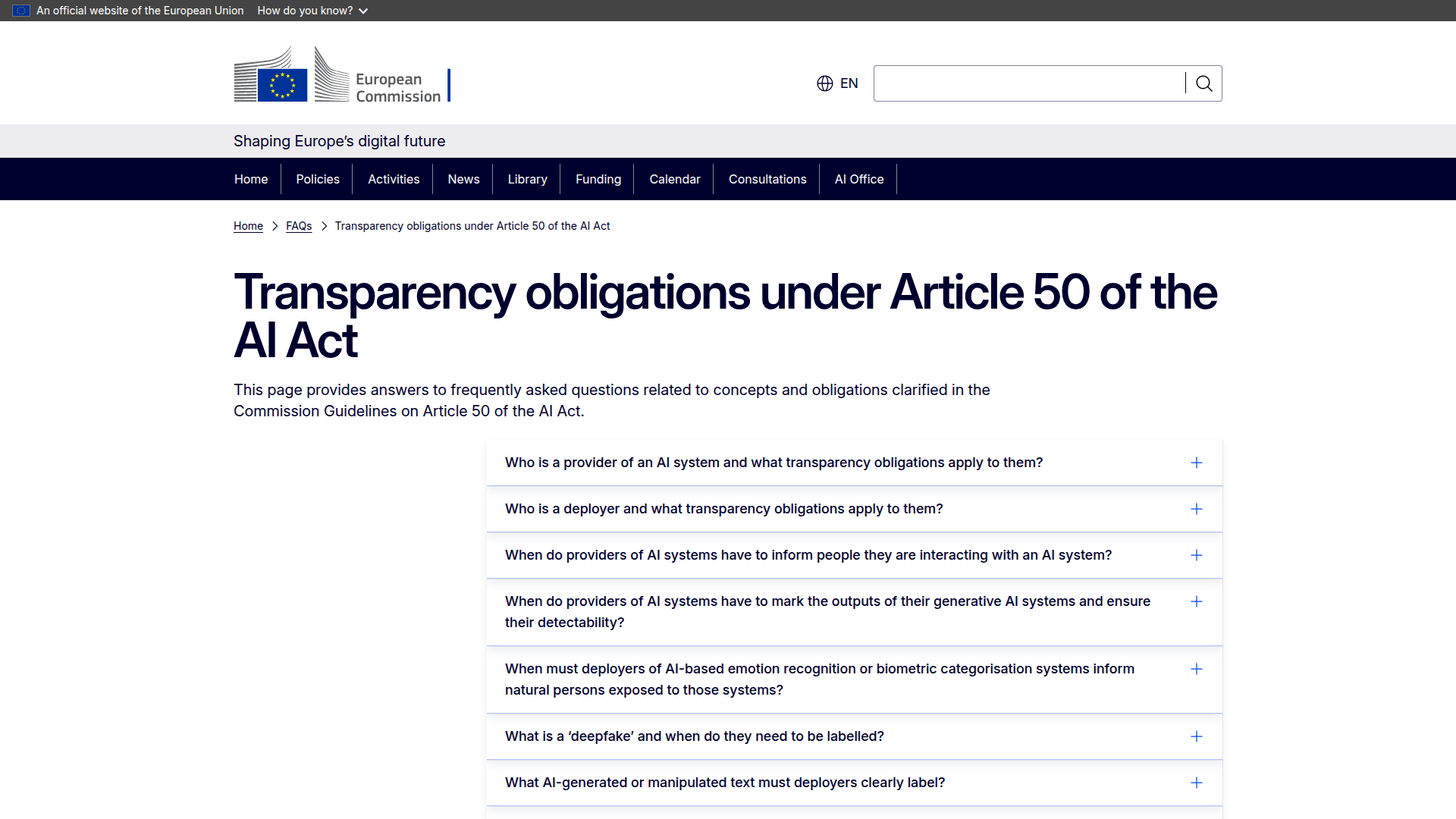 The Commission’s Article 50 FAQ captured November 14, 2026. The separate questions are a useful starting point for a role-specific review, not a certification of any application.
An engineering team can make that review concrete without deciding the legal outcome itself. Map the content path: model request, generated draft, editor changes, export, and publication. At each step, identify the responsible system and what evidence survives. A publication interface can display a disclosure while the export path silently drops it; testing only the web preview would miss that gap.
Use a responsibility table rather than a single compliance checkbox:
| Review item | Evidence to assemble | Question for the responsible reviewer |
|---|---|---|
| Provider mechanism | Dated provider statement and model route | Does it cover the system actually used? |
| Application transformation | Editor/export behavior and version | What changes after generation? |
| Publication context | Intended audience and presentation | Which disclosure conditions apply here? |
| Organizational role | Product and distribution description | Who has which obligation? |
| Release approval | Named review owner and decision | What assumptions must remain true? |
This table is a proposed implementation aid. It is not a substitute for the applicable legal text or professional review. The official Article 50 text is the place to check the underlying duties and conditions; an engineering blog cannot determine how they apply to every product.
Use the Code of Practice as a review source
The Commission publishes a Code of Practice on Transparency of AI-Generated Content. Its existence provides a primary reference for the transparency discussion. It does not make a screenshot of the page evidence that your implementation satisfies it.
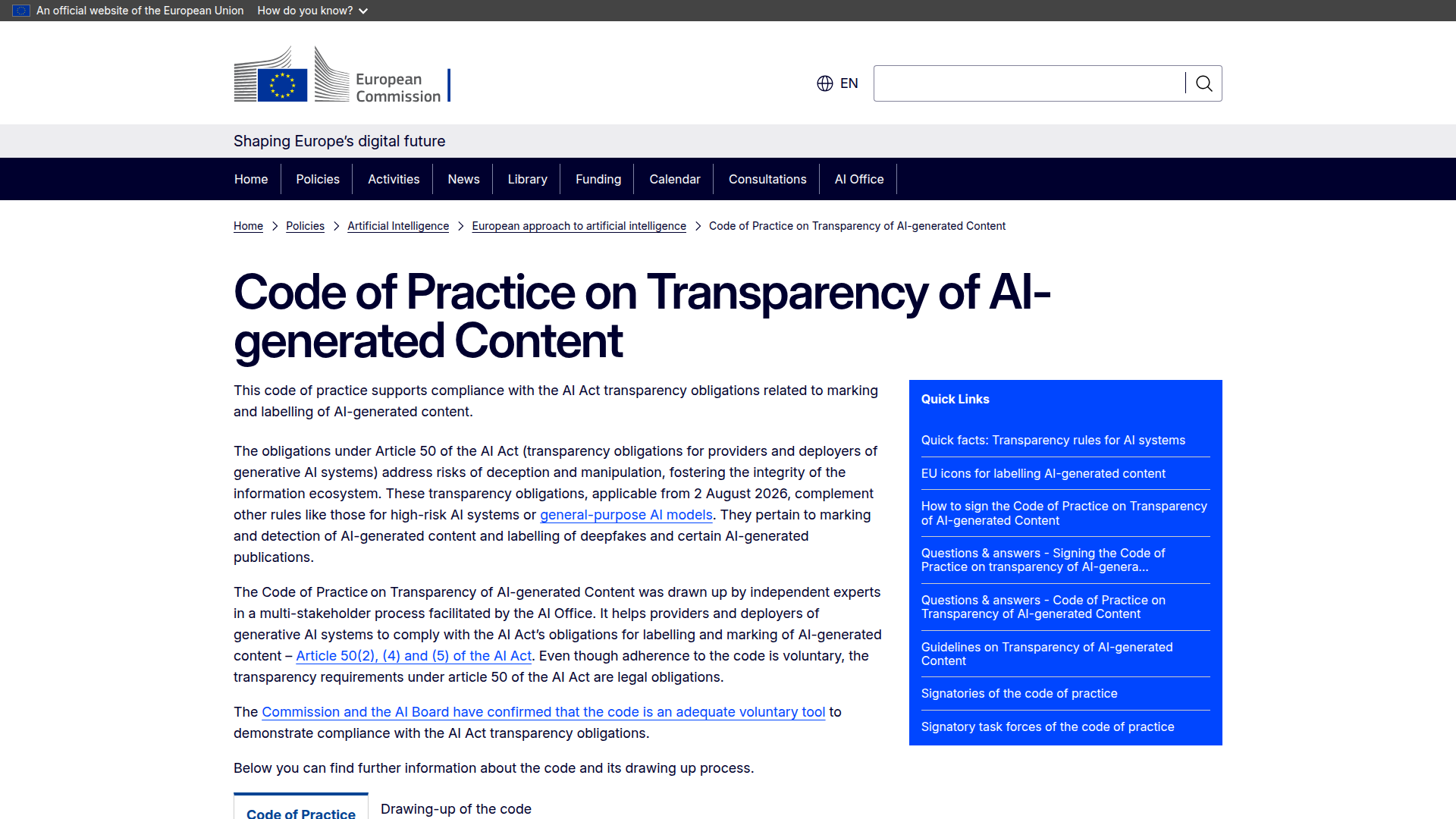 The official Code of Practice page captured November 14, 2026. Keep the relevant document version with the review, rather than relying on a remembered summary.
For a release packet, record the source URL, retrieval date, applicable document version, and the team’s interpretation as separate entries. This makes changes reviewable. When guidance changes, the team can revisit the specific assumption instead of rediscovering why a generic “AI transparency” ticket was closed months earlier.
The same discipline helps support teams. Give them wording supported by the implementation, such as “this draft was generated through our Claude integration and reviewed before publication,” when those facts are actually recorded. Do not tell them to promise reliable detection of any pasted text or to identify the person behind a watermark.
File credentials are another boundary
Anthropic separately describes C2PA credentials for supported files such as PNG, JPG, and SVG. These are signed metadata notes about Claude’s involvement. They differ from the statistical pattern in text. An export pipeline should therefore treat a file and a pasted paragraph as distinct artifacts.
For an image workflow, inspect the exact file emitted by the provider and the final file delivered to the reader. Record whether the processing path preserves the credential. A thumbnailer, format conversion, and download endpoint are separate steps to check; do not assume that a preview proves the downloadable asset has the same metadata.
For text, track revisions without pretending that an edit history is a detector. If a human rewrites the headline after generation, the application can record that edit. It cannot infer from the saved request alone how much of a later copy remains model-authored. That distinction should be reflected in labels and support documentation.
A practical verification checklist
Use harmless fixtures and record actual observations for each supported output route:
- Identify the model and route used by the application, including fallback behavior.
- Save the current provider statement that covers that route; flag unclear coverage for follow-up.
- Check whether any detector access is actually approved and whether its documented use fits the product.
- Trace a draft through editing, export, and publication, including copied text and downloaded files.
- Verify the disclosure presented in each delivery path against the review decision.
- Keep uncertainty and service failure visible; do not silently label unchecked content as verified.
- Assign an owner to revisit the record when models, export code, or guidance changes.
An especially useful failure test is to make the verification service unavailable. The product should preserve the draft and explain the pending review state. Automatically treating an unavailable check as a successful check turns an operational outage into an evidence error.
Choosing a model does not settle provenance
The SandBase Claude directory can help compare Claude model options. It is a model-discovery destination, not a claim that SandBase supplies Anthropic’s private detection API or certifies a watermark on every response. Confirm the exact provider behavior for the route you intend to use.
For the related problem of capturing application evidence, see agent observability: logs, traces, and debugging. Store only the evidence needed for the decision, and keep a clear distinction between what your application observed and what a provider document says.
Questions that need precise answers
Can a watermark identify the customer who wrote a prompt? Anthropic’s explanation does not describe such an identifier. Do not promise attribution to a person or organization.
Can we detect every Claude-written sentence? This article provides no such evidence. Access restrictions and signal limitations rule out presenting detection as a universal guarantee.
Does provider watermarking finish our Article 50 review? No. The application role and publication context still require their own assessment.
A useful release packet is specific: the model route, the provider statement, the transformation path, the disclosure decision, and the unresolved limits. That is more actionable than a badge claiming all text has been verified.
Found this useful? Share it